Some clients, often startups and crypto companies, would rather pay you in USDT than by bank. If you want to get paid in USDT, the upside is money that lands in minutes instead of days. But a USDT payment can't be pulled back, and a wrong network can lose it. Here's how to set it up properly.
The numbers, checked on 28 November 2026:
- 3rd. Pakistan's place in Chainalysis's 2025 Global Crypto Adoption Index, after India and the US, as reported by The Block in September 2025.
- March 2026. When Parliament's Virtual Assets Act became law, making the Pakistan Virtual Assets Regulatory Authority (PVARA) the permanent regulator, according to Profit.
- $1.76 billion. What Pakistani freelancers earned from abroad in FY2025-26, according to State Bank data reported by Profit.
Key takeaways
- Agree three things before any money moves: USDT or USDC, the network, and the exact amount in dollars.
- Send your address for one network only, and tell the client in writing not to use any other.
- Ask for a small test payment from a new client. A USDT transfer can't be reversed by the sender, or by you.
- Only trust what shows in your own balance. Screenshots and transaction links can be faked.
- Keep the invoice and the transaction record for every payment. Pakistan's tax rules for crypto income are still unsettled.
Is it legal to get paid in USDT in Pakistan?
Here's where things stand, from the regulator and the business press:
- The law. Parliament passed the Virtual Assets Act in March 2026. It replaced the July 2025 ordinance and gave PVARA permanent status, Profit reported.
- Banks. In April 2026 the State Bank issued BPRD Circular Letter No. 10 of 2026, letting banks open accounts for PVARA-licensed virtual asset service providers and their customers, PVARA announced.
- Exchanges. PVARA gave Binance and HTX no-objection certificates in December 2025 to start registering. PVARA said these "are not blanket approvals", Profit reported.
- Tax. No crypto-specific tax rate has been published. Income is still income, so record what you earn and ask a tax adviser how to declare it.
This is a summary, not legal or tax advice. The rules are new and still changing.
Should I ask for USDT or USDC?
Most of the decision comes down to what your client has. A company paying from a USDC balance shouldn't have to buy USDT just for you, and the other way round.
In HandlePay, 1 USDT and 1 USDC both count as $1 in your balance, and both work on all four networks it supports.
Which network should my client use to send USDT?
This is the step to get right. The same stablecoin travels on different networks, and the sending screen usually asks the client to pick one.
HandlePay supports four networks for USDT and USDC:
- BNB Smart Chain (BEP20)
- Arbitrum One
- Base
- Optimism
HandlePay doesn't support Tron (TRC20) or Solana. If a client offers to pay on Tron, ask them to use one of the four networks above instead. Don't send USDT on Tron or Solana to a HandlePay address, and only send the stablecoin the app shows for that network.
Put it on your invoice in one line: "Pay in USDT on BNB Smart Chain (BEP20) only, to this address." Our guide to invoicing international clients from Pakistan covers what else a clean invoice needs.
Where should I receive USDT: an exchange, a wallet or an app?
Here's how the main routes compare, from each provider's own pages on 28 November 2026:
| Where you receive | How it reaches your bank | Watch out for |
|---|---|---|
| Exchange account (Binance, Bitget) | P2P sale to a local buyer who pays you rupees | The buyer sets the rate, and the rupees come from a stranger's account |
| Your own wallet (Trust Wallet, MetaMask) | Move it to an exchange or app first, then cash out | Only you hold the recovery phrase. Lose it and the money is gone |
| nsave | In-app deposits take USDT and USDC on Solana only, per nsave's May 2026 guide | PKR rate and fee shown in the app, not published |
| HandlePay | Cash out to any Pakistani bank at the Google rate for 0.4%, within minutes | Four networks only: no Tron (TRC20) or Solana |
Fees and networks change, so check each provider before you send. Exchanges may also charge a network fee on withdrawals.
The P2P route is the familiar one, and it's where the risk sits: you can't choose who sends you the rupees. We set out the alternative step by step on cash out USDT to PKR without P2P.
How do I check that a USDT payment is real?
USDT payments draw the same tricks as bank payments, plus a few of their own:
- Fake proof. A screenshot of a "sent" transfer, or a link to a look-alike block explorer page.
- Look-alikes. Scammers can send a fake asset that uses the USDT name. Trust what shows as USDT in your own app's balance.
- Wrong network on purpose. A client "accidentally" sends on an unsupported network, then claims they've paid.
A test payment of a few dollars from every new client settles most of this. We cover the bank-transfer versions of these traps in freelancer payment scams in Pakistan.
Can a client take back a USDT payment?
This is the biggest difference from PayPal or card payments, where a client can open a dispute months later. With USDT, the risk moves to the sending moment. So the rules are simple: one address, one network, a test payment first, and the full amount once the test has landed.
How do I turn USDT into rupees?
A worked example with 1,000 USDT from a client:
- Your client sends 1,000 USDT on BNB Smart Chain to your HandlePay address.
- It lands in your balance as $1,000. HandlePay charges nothing to receive it.
- You cash out the full amount. The 0.4% fee is $4, so $996 is converted to rupees at the Google rate and sent to your bank.
The first time you cash out, you verify your identity in the app with your CNIC or passport and a selfie. Every fee is listed on the HandlePay fees page.
Where HandlePay fits
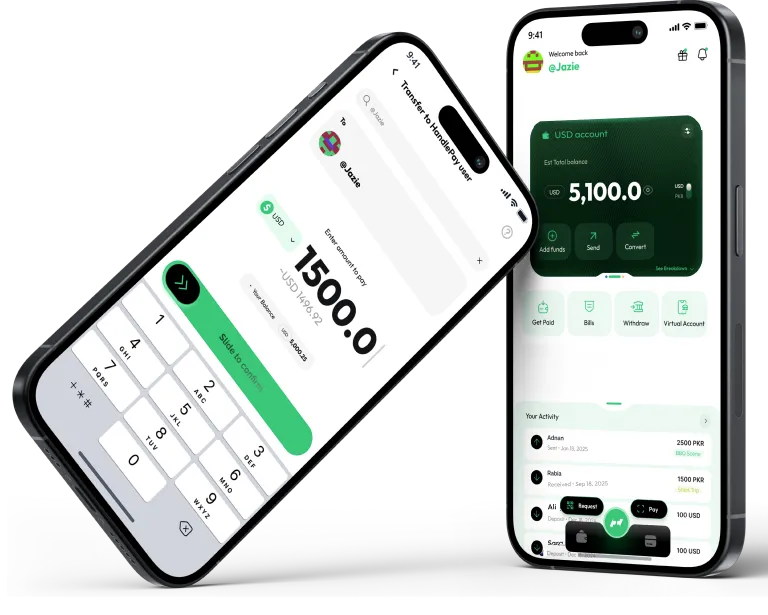
HandlePay is a dollar account for Pakistanis. Your balance is held as USD stablecoins (USDT and USDC) that only you control, and HandlePay can't freeze or move your money.
Clients who pay in USDT or USDC send to your address on BNB Smart Chain, Arbitrum One, Base or Optimism. Clients who pay by bank use US account details in your own name, by ACH or SWIFT. Both land in the same balance, and you cash out to any Pakistani bank when you choose.
Get paid in USDT, cash out to your bank
Receive USDT or USDC on four networks and cash out to any Pakistani bank at the Google rate.
Sources
- The Block, "India leads global crypto adoption, APAC emerges as fastest-growing market: Chainalysis", 4 Sep 2025: https://www.theblock.co/news/ecosystems/2025-09-04-india-leads-global-crypto-adoption-chainalysis-369420
- Profit by Pakistan Today, "Virtual Assets Act becomes law as Pakistan moves to regulate crypto sector", 7 Mar 2026: https://profit.pakistantoday.com.pk/2026/03/07/virtual-assets-act-becomes-law-as-pakistan-moves-to-regulate-crypto-sector/
- Pakistan Virtual Assets Regulatory Authority on X, on SBP BPRD Circular Letter No. 10 of 2026, 14 Apr 2026: https://x.com/PakistanVARA/status/2044081768329064778
- Profit by Pakistan Today, "PVARA: Binance, HTX NOCs first step in phased crypto regulation", 14 Dec 2025: https://profit.pakistantoday.com.pk/2025/12/14/pvara-binance-htx-nocs-first-step-in-phased-crypto-regulation/
- Profit by Pakistan Today, "Pakistan's freelancer earnings hit record $1.76 billion in FY26", 21 Jul 2026: https://profit.pakistantoday.com.pk/2026/07/21/pakistans-freelancer-earnings-hit-record-dollar176-billion-in-fy26
- UrduPoint, "Crypto in Pakistan: Is It Legal, and What the Current Rules Say", figures as of 25 Nov 2026: https://www.urdupoint.com/business/explained/is-crypto-legal-in-pakistan.html
- nsave, "How to Receive USDT and USDC in Pakistan", 20 May 2026: https://www.nsave.com/pakistan/receive-usdt-and-usdc
- HandlePay, "Cash out USDT to PKR without P2P", checked 28 Nov 2026: https://handlepay.io/cash-out-usdt-pakistan/
FAQs
Can I receive USDT on TRC20 in HandlePay?
What's the difference between USDT and USDC?
Do I pay tax on income received in USDT in Pakistan?
Is it safe to sell USDT on P2P in Pakistan?
Should I invoice in USDT or in dollars?
HandlePay Team
Our mission is to make international money work for everyday people, freelancers, and businesses in Pakistan.