Freelancer payment scams in Pakistan rarely look like scams. They look like a busy client, a generous offer or a small favour. And they're common enough that you should expect to meet one.
The numbers, checked on 26 November 2026:
- 150,000+. Cybercrime complaints the National Cyber Crime Investigation Agency (NCCIA) received in a year, over 81,000 of them about financial fraud, Minister of State for Interior Talal Chaudhry told the National Assembly in January 2026.
- Rs 8.32 billion. What people who complained to the NCCIA lost to online fraud across three years, in 227,757 complaints, according to official documents reported by The Express Tribune in September 2026.
- About $16 billion. Fraud losses Americans reported to the US Federal Trade Commission in 2025, the highest on record.
Key takeaways
- A screenshot, a PDF or an email is not a payment. Only your own balance is.
- Never refund an "overpayment" until the full amount has landed and cleared in your account, and refund it the same way it came.
- Taking an Upwork or Fiverr client off-platform before a contract removes the platform's payment protection, and both platforms call it a scam signal.
- PayPal and card payments can be pulled back for up to 180 days. Know the risk of the route you accept.
- Never let anyone receive their money through your account. It's the fastest way to get your own account closed.
What are the most common freelancer payment scams in Pakistan?
Here's how each one plays out, and the one check that beats it:
| Scam | How it works | The check that stops it |
|---|---|---|
| Fake payment proof | Client sends a "payment sent" screenshot, bank PDF or email and asks you to start or deliver | Open your own app or bank. If it isn't in your balance, you haven't been paid |
| Overpayment refund | Client "accidentally" sends too much and asks you to return the difference by JazzCash, Easypaisa or crypto | Refund nothing until the full amount has landed and cleared. Refund only to the original sender, the same way it came |
| Off-platform offer | A new Upwork or Fiverr client offers to pay you directly to "save fees" | Keep the contract and the money on the platform until you've worked together and been paid there |
| Chargeback | Client pays by PayPal or card, gets the work, then disputes the payment | Use milestones or part-payment upfront for new clients, and keep proof of delivery |
| Account borrowing | Someone asks to receive "their client's" payment in your account and forward it | Say no. Never receive money that isn't for your own work |
Is a payment screenshot proof that I've been paid?
The classic version: a new client sends a screenshot of a transfer and says the money "takes 24 hours to show". They ask you to send the files now so their team can start.
Three rules:
- Check the balance yourself. Open your app or bank directly. Never use a link or a "track your payment" page the client sends.
- Ignore payment emails from strangers. Upwork's own scam guidance tells you not to click links in unexpected emails and to check the sender's address, because phishing emails copy its look.
- Hold the final files. Send previews or watermarked work until the money is in your balance.
A real ACH payment into HandlePay lands within 24 hours. A SWIFT payment takes 3 to 4 days. Either way, you see it in your balance, not in a picture of someone else's screen.
How does the overpayment scam work?
ProZ, the translators' marketplace, describes the same pattern in its guide to the overpayment scam: a large job, payment in advance, a counterfeit payment, then a request to send money "back".
The Pakistani version usually skips the cheque. The "overpayment" arrives as a screenshot, and the refund goes to a mobile account in a different name. Two signs give it away:
- The refund goes somewhere different from where the payment came from.
- There's a rush: "my boss will fire me", "I need it before the bank closes".
If someone genuinely overpays you, the money is already in your balance. You can refund it to the same sender, by the same route, whenever you're ready. Nobody honest needs it sent to a third person within the hour.
Is it safe to take an Upwork or Fiverr client off-platform?
Upwork's Scams FAQ is blunt: if payments and communication happen outside Upwork, you forfeit its protection, and it can't help recover payments made outside the platform. Fiverr allows third-party communication only after an order has been placed, and repeated or severe violations can get your account suspended.
So the "let's skip the platform fee" offer costs you twice: no protection if the client doesn't pay, and a real risk to the profile you spent years building.
Long-standing direct clients are different. Once you've worked with someone and been paid properly, moving future work to a direct invoice is a normal business choice, and the platform's rules on that are worth reading first. Our guide to invoicing international clients from Pakistan covers what a direct invoice should show.
Can a client take back a payment after I deliver the work?
This is the scam that hits freelancers who did everything right. The work is delivered, the money arrived, and two months later the client files a dispute saying they never got it.
| How the client pays | Can it be pulled back? | What protects you |
|---|---|---|
| PayPal (goods and services) | Item Not Received disputes up to 180 days after payment | PayPal Seller Protection, where the payment qualifies |
| Card payment | Chargebacks within 180 days of the transaction | Proof of delivery; the card issuer decides |
| Upwork or Fiverr | Through the platform's dispute process | The platform's payment protection, only if you stayed on it |
| ACH bank transfer | Erroneous entries (duplicates, wrong amount, wrong receiver) can be reversed within 5 banking days | An account in your own name and a clear invoice |
Sources: PayPal "Dispute filing timeframes" and "What is a chargeback", Nacha "Reversals and Enforcement", Upwork and Fiverr help centres, all checked 26 November 2026.
For a new client on a big job, ask for a milestone or part of the fee upfront, and keep a record of every file you send. That record is what wins a dispute.
Why would someone want to use my account to receive money?
It's often pitched as easy money: "my client pays you, you keep 10%". Or as a favour for a cousin whose Payoneer got blocked.
Every payment into an account in your name is, on paper, your income. If the sender turns out to be a victim of fraud, the trail leads to you. If you've read our post on what to do when Payoneer blocks your account, you'll know how hard it is to get an account back once a provider has closed it. Only receive money for work you did yourself.
How do I check that a payment is real?
A five-point check before you deliver or refund anything:
- The money is in your balance. Not "processing", not a screenshot.
- The sender's name matches the client on your invoice or contract.
- The amount matches the invoice. If it's more, wait until it clears and refund only the difference to the same sender.
- Nobody has asked for an OTP, PIN, password or "release fee". Fake support agents on WhatsApp ask for exactly these.
- The details your client paid to are yours, in your own name, copied from your own app.
Not sure which apps are worth trusting with your money in the first place? We compared the main options in safe payment apps for freelancers in Pakistan.
What should I do if I've been scammed?
Speed matters most with the bank or app. The sooner they know, the better the chance of stopping a transfer that hasn't settled.
Keep everything: chats, emails, screenshots of the fake proof, the account or number you were asked to pay, and transaction IDs. The NCCIA will ask for them. If it happened on a platform, report there too, because the same scammer is usually working through other freelancers on the same day.
Where HandlePay fits
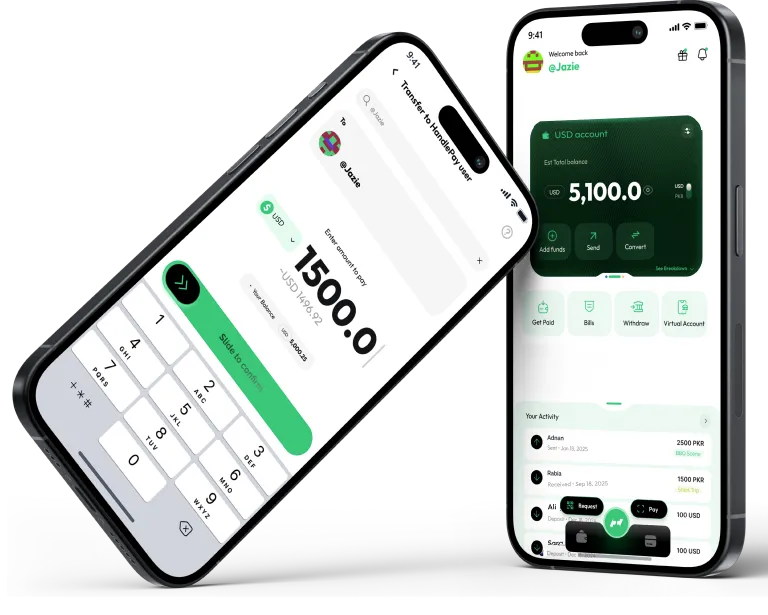
HandlePay gives you a dollar account with US account details in your own name, so clients pay you directly by ACH or SWIFT. You check every payment in your own balance, not in a screenshot.
Your balance is held as USD stablecoins (USDT and USDC) that only you control, and HandlePay can't freeze or move your money. You cash out to any Pakistani bank at the Google rate whenever you choose. If you want to check how it works before you trust it with a payment, we've set it out on is HandlePay safe.
Get paid into an account in your own name
Share your US account details with clients and see every payment land in your own balance.
Sources
- Profit by Pakistan Today, "NCCIA received over 150,000 complaints last year, including 81,000 linked to financial fraud, NA told", 17 Jan 2026: https://profit.pakistantoday.com.pk/2026/01/17/nccia-received-over-150000-complaints-last-year-including-81000-linked-to-financial-fraud-na-told
- ProPakistani, "Cyber Fraudsters Defraud Over 227,000 Pakistanis" (reporting The Express Tribune), 11 Sep 2026: https://propakistani.pk/2026/09/11/cyber-fraudsters-defraud-over-227000-pakistanis/
- US Federal Trade Commission, "FTC Data Show People Reported Losing $3.5 Billion to Imposter Scams in 2025", 15 Jun 2026: https://www.ftc.gov/news-events/news/press-releases/2026/06/ftc-data-show-people-reported-losing-3-point-5-billion-imposter-scams-2025
- Upwork, "Recognize red flags and avoid scams", checked 26 Nov 2026: https://support.upwork.com/hc/en-us/articles/35088484250003-Recognize-red-flags-and-avoid-scams
- Upwork, "Scams Frequently Asked Questions", checked 26 Nov 2026: https://support.upwork.com/hc/en-us/articles/34385274054547-Scams-Frequently-Asked-Questions
- Fiverr, "Stay protected: Fiverr's off-platform policy", checked 26 Nov 2026: https://help.fiverr.com/hc/en-us/articles/12792122691601
- PayPal, "Dispute filing timeframes", checked 26 Nov 2026: https://www.paypal.com/us/cshelp/article/dispute-filing-timeframes-help1173
- PayPal, "What is a chargeback, and why did I get one?", checked 26 Nov 2026: https://www.paypal.com/chargebacks
- Nacha, "Reversals and Enforcement", checked 26 Nov 2026: https://www.nacha.org/rules/reversals-and-enforcement
- ProZ.com, "How the overpayment scam works on freelancers", checked 26 Nov 2026: https://go.proz.com/blog/how-the-overpayment-scam-works-on-freelancers
- ProPakistani, "Cyber Helpline 1799 Launched", 3 Jun 2025: https://propakistani.pk/2025/06/03/cyber-helpline-1799-launched/
FAQs
Can a client cancel a bank transfer after it reaches me?
Is it a scam if a client asks for my US account details?
Will Upwork help if a client I met there pays me outside Upwork?
Where do I report an online payment scam in Pakistan?
HandlePay Team
Our mission is to make international money work for everyday people, freelancers, and businesses in Pakistan.