A Karachi freelancer's dollars disappeared into a month of bureaucracy and hidden fees. Getting paid shouldn't cost Pakistani freelancers 3% of every payment, yet for many it does. Here's why millions of Pakistanis are learning the same lesson, and what to do about it.
Six months ago, I made a decision that seemed responsible at the time. I handed over custody of my money to a bank.
I'm a freelancer based in Karachi. My clients are global, my skills are in demand, and my income is in US dollars. For years, I received payments in stablecoins: instant, borderless and entirely under my control. But when I landed a steady remote job with monthly payroll, I thought it was time to "go legit" and open a freelancer bank account.
What followed was a masterclass in what happens when someone else controls your money.
I visited four different bank branches across Karachi. One bank, which had freelancer accounts plastered all over its website, sent me back three or four times. Each visit brought new document requests and new excuses: "The person who handles these accounts is out of office." "Come back tomorrow." "We need one more verification."
It took an entire month to open an account.
When the first wire finally hit my account, three weeks after my client sent $1,750, I received $1,715. The bank had taken $35 in fees. Then came the exchange rate: the market was at 282 PKR per dollar, but the bank gave me 280.15 (still better than some other remittance providers). Another loss on every dollar.
In total, I lost nearly 3% of my earnings. Not to mention the month of waiting, the hours spent in bank branches, and the complete lack of control over when, or if, my money would arrive.
Here's what I realised: the fees and delays weren't separate problems from custody. They were consequences of it. The moment I handed my dollars to the bank, I accepted its terms. Its timeline. Its exchange rate. Its fees. I had no leverage, no alternatives and no control.
That's the hidden tax of custodial finance.
How do Pakistani freelancers get paid, and what does it cost?
In fiscal year 2025, overseas Pakistanis sent home a record $38.3 billion in remittances through formal channels, a 27% increase on the previous year. That's only the tip of the iceberg. An estimated $4 to 6 billion flows through hawala and hundi networks every year, informal channels that exist precisely because the formal system is so broken. Some estimates put total remittance flows as high as $50 billion once informal channels are included.
Hawala has existed for centuries, long before banks. A construction worker in Dubai hands cash to a hawaladar, gets a code, and calls his brother in Shujabad, a small town near Multan. That evening, his brother walks into a shop in the local bazaar, says the code, and walks out with rupees. No paperwork. A better rate than any bank. The hawaladars settle up later through trade or reciprocal transfers.
It's illegal. It's also how a huge share of Pakistan's money actually moves.
People use informal channels despite the risks because they keep control over their money. Even inside a hawaladar's trust-based network, users often get better exchange rates, faster settlement and fewer questions than they do in the formal banking system.
For Pakistan's 3+ million active freelancers earning dollars from global clients, these costs add up to millions of dollars lost every year. The President of the Global Freelancers Union put it bluntly:
"Earning money is not the real problem. The problem is bringing it back to Pakistan."
We're the 4th largest freelancing market in the world. IT exports hit $3.8 billion in FY2025. We've proven we can compete on a world stage. What we haven't solved is who controls what we earn, and at what cost.
Why are so many Pakistanis moving to digital dollars?
Pakistan ranks 3rd in the world for cryptocurrency adoption in Chainalysis's 2025 Global Crypto Adoption Index. Only India and the United States rank higher.
That isn't a coincidence. It's a response to two parallel crises: currency depreciation and custody failure. Consider the numbers:
- In 2020, one US dollar bought around 160 Pakistani rupees.
- By late 2023, the rate crossed 307 rupees per dollar.
- Today it hovers around 280. The dollar costs 75% more than it did five years ago, which means rupee savings lost over 40% of their dollar value.
When your savings lose 40% of their dollar value in half a decade, holding them in rupees becomes slow-motion wealth destruction. That drove millions of Pakistanis to dollar-denominated alternatives: stablecoins that keep their purchasing power whatever happens to the rupee.
But this is where the two crises meet. Seeking stable value doesn't help if someone else controls that value.
Many Pakistanis discovered stablecoins through exchanges such as Binance, FTX, KuCoin and local platforms. They moved their savings out of depreciating rupees into digital dollars and thought they were protected. Then came the collapses.
What did the FTX collapse teach us?
In November 2022, FTX, one of the world's largest cryptocurrency exchanges, collapsed overnight. $8 billion in customer funds vanished. Its founder, Sam Bankman-Fried, was later convicted of fraud and sentenced to 25 years in prison.
FTX wasn't alone. Celsius. BlockFi. Voyager. Genesis. In a single year, billions of dollars held on custodial platforms disappeared, were frozen, or got locked in bankruptcy proceedings that would take years to resolve.
One FTX customer lost $174,000, 60% of his portfolio. He eventually sold his bankruptcy claim for $19,000, accepting 11 cents on the dollar just to get some cash back.
The common thread? Every one of these victims had escaped their local currency's depreciation only to lose everything to custody failure. They traded one risk for another, and the second one proved catastrophic.
In crypto, there's a saying: "Not your keys, not your crypto."
When you hold assets on an exchange, you don't control them. You hold an IOU, a promise that the platform will let you withdraw when you ask. If the exchange gets hacked, goes bankrupt, freezes your account or decides to restrict users in your country, that promise evaporates.
Self-custody means holding your own private keys, the cryptographic proof that you, and only you, control your funds. No exchange can freeze your account. No bankruptcy proceeding can lock your money away for years.
When you hold your own keys, your money is actually yours.
Is self-custody with stablecoins completely risk-free?
Before going further, an important caveat: even self-custody has layers of centralisation risk.
The most popular stablecoins, the dollar-pegged tokens millions use to escape local currency depreciation, are issued by centralised companies. Tether (USDT) and Circle (USDC) keep administrative control over their tokens. They can, and do, freeze addresses.
The numbers are sobering. Between 2023 and 2025, Tether blacklisted 7,268 addresses holding a combined $3.29 billion. Circle blacklisted 372 addresses totalling $109 million. These freezes usually target addresses linked to fraud, sanctions violations or law enforcement requests, but the capability exists whatever the reason.
In practice, holding stablecoins yourself is meaningfully better than holding them on an exchange. You're protected from platform bankruptcy, hacks and account freezes by the platform itself. You're not fully immune to action by the stablecoin issuer.
That isn't a reason to avoid stablecoins. For most Pakistanis, the realistic alternatives (rupee savings that depreciate, bank accounts with arbitrary restrictions, or cash that can be stolen) carry far greater practical risk than the possibility of issuer intervention.
The point is control: each layer of custody you remove is a layer of risk you remove.
Why does self-custody matter more in Pakistan?
In developed economies with stable currencies and working banks, self-custody is often framed as an ideological choice, a way to opt out of traditional finance on principle. In Pakistan, it's becoming a practical necessity.
- No PayPal. Despite being the 4th largest freelancing market in the world, Pakistan still doesn't have PayPal. Freelancers are pushed into workarounds: Payoneer (with its conversion spread and annual fees), Wise (limited availability), or informal channels that carry fraud risk and eat into earnings.
- Banking friction. Opening a freelancer account should be simple. Instead it can mean weeks of branch visits, inconsistent document requests and staff who don't know their own bank's products. Once you have the account, international wires take days or weeks to clear, and you convert to rupees at whatever rate the bank offers.
- Currency volatility. Anyone holding savings in PKR has watched their purchasing power erode. That isn't pessimism, it's simple maths.
- Regulatory uncertainty. Pakistan has set up a Crypto Council, which recognises digital assets, but the path forward is still unclear. Accounts can be frozen. Rules can change. Direct control over your assets is protection.
Self-custody tackles these problems by removing the intermediaries that cause them. When you control your own money, no bank decides when to release your funds, nobody forces a conversion at a bad rate, and you don't wait weeks for "verification".
Why haven't more people switched to self-custody?
If self-custody is so powerful, why aren't more people using it? The barriers are real, and they go beyond "it's too complicated".
- Fear of irreversible loss. A traditional self-custody wallet has no "forgot password" option. Lose your private keys or recovery phrase and your funds are gone. Understandably, that terrifies people.
- Lack of education. Seed phrases, private keys, gas fees and network selection are foreign to anyone who hasn't spent time in crypto. Without understanding, there's no confidence to act.
- Trust in familiar institutions. Banks are flawed, but familiar. A bank account feels "real" in a way a digital wallet doesn't, even when the bank is less reliable.
- No safety net. Self-custody doesn't come with insurance or regulatory protection. For people used to at least the illusion of protection, that feels exposed.
- Complex tools. Traditional wallets like MetaMask, Ledger and Trust Wallet were built for crypto-native users. For the average Pakistani freelancer, they're genuinely intimidating.
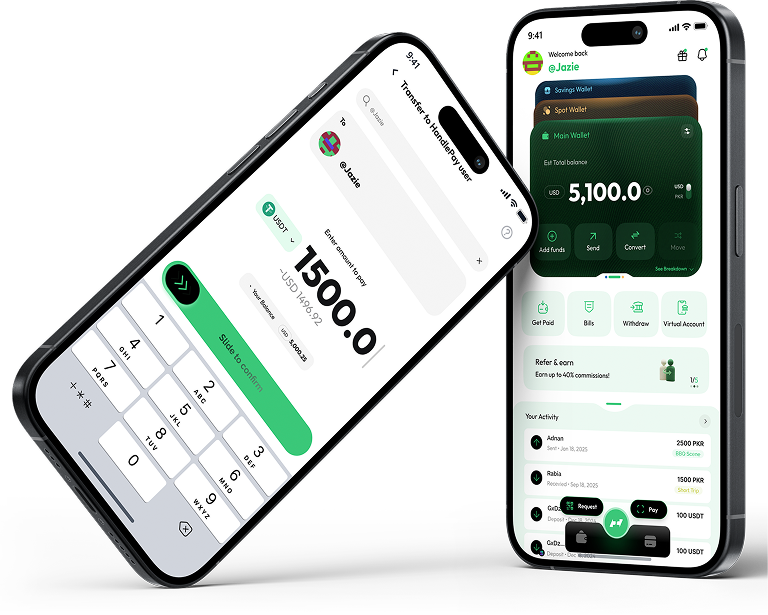
That's starting to change. A new generation of products combines the security of self-custody with the ease of a fintech app. Instead of making you manage 24-word seed phrases and blockchain settings, they handle the complexity for you, with recovery options, simple screens and guidance built into the experience.
At HandlePay, this is exactly the problem we're solving. Pakistanis shouldn't have to choose between controlling their money and being able to use it. And earning in dollars shouldn't mean losing 3% to 5% just to reach your own funds.
What does self-custody look like day to day?
- Receiving payments: instead of waiting weeks for a wire and losing money to a forced conversion, your payment arrives in dollars in an account only you control. No bank decides when to release it.
- Holding value: instead of watching savings shrink with the rupee, you hold dollars yourself. No exchange can freeze them and no platform can go bankrupt with them.
- Spending: when you need groceries, bills or dinner with friends, you convert and spend, without juggling accounts or sending screenshots on WhatsApp to prove you paid.
- Security: if a platform you use gets hacked or goes bankrupt, your funds stay with you. There's no queue of creditors ahead of you.
None of this is science fiction. The infrastructure exists today. What's been missing is the bridge: products that make self-custody usable for normal people, not just crypto enthusiasts.
The bottom line
Pakistan has one of the world's most active crypto communities, with an estimated 27 million people holding digital assets. We have millions of freelancers earning foreign currency, and we receive more than $38 billion a year through formal remittance channels alone.
We've also learned, painfully, what happens when we trust others to hold our money. We've watched our currency depreciate, waited weeks for bank wires, lost earnings to fees and spreads, and seen billions vanish from exchanges that promised safety.
Self-custody isn't anti-bank or anti-government. It's recognising that the fees, delays and restrictions you face are consequences of custody arrangements you didn't choose. Hold your own keys and you remove the single points of failure, and the middlemen who profit from every transaction.
For Pakistanis dealing with currency swings, banking friction and regulatory uncertainty, self-custody is no longer a luxury. The question isn't whether you can afford to take control of your money. It's whether you can afford not to.
Stop paying the hidden tax
Get paid from abroad in your own name, keep it in dollars, and cash out to PKR when you choose.
Sources
- Chainalysis, 2025 Global Crypto Adoption Index
- TRM Labs, 2025 Crypto Adoption Report
- State Bank of Pakistan, FY2025 remittance data
- AMLBot, Stablecoin Freezes Report 2023 to 2025
- Pakistan Software Export Board, IT export statistics
- Pakistan Freelancers Association, industry reports
FAQs
HandlePay Team
Our mission is to make international money work for everyday people, freelancers, and businesses in Pakistan.