The certificate is easy to download. The purpose code your bank attached to the payment when it landed is what counts, and that code is hard to change afterwards.
There's a lot riding on it. Pakistani freelancers earned a record $1.76 billion in FY26, State Bank data reported by Profit shows. In June 2026, the budget extended the 0.25% final tax rate for IT exporters and freelancers until 2029.
Key takeaways
- Your bank issues the PRC, not Payoneer, Upwork or your client.
- Purpose code 9186 is the State Bank's code for freelance computer and information services. Code 9471 is for family remittances, and it won't help you at tax time.
- Export income can be taxed at a 0.25% final rate if you're registered with PSEB, or 1% if you're not. Without proof, it can fall into the normal tax slabs.
- UBL gives a free e-PRC to every freelancer account holder. Meezan issues one automatically on Payoneer withdrawals.
- Ask your bank how it codes a transfer before your first big payment, not after.
What is a PRC for freelancers?
Most banks now issue it electronically, as an e-PRC you can download or have emailed. Bank AL Habib, for example, lets you download a PRC for a single payment from its ePRC portal, or request an sPRC, a statement covering several payments over a period in the same financial year.
A PRC is tied to one person. Bank AL Habib issues it only to the account holder the payment was received for. So if a friend or family member receives your client's money for you, the certificate is theirs, not yours.
What is purpose code 9186?
Every foreign payment that reaches a Pakistani bank gets a purpose code. Two are worth knowing:
| Purpose code | What it means | What it does for a freelancer |
|---|---|---|
| 9186 | Freelance of computer and information services | Counts as IT export income; the PRC supports the 0.25% or 1% rate |
| 9471 | Workers' remittances, other sectors | Family money from Pakistanis abroad; doesn't prove export income |
Source: State Bank of Pakistan purpose of payment codes, as listed by NAB, checked 10 November 2026.
The difference shows up when you file. A payment for a website you built that lands as 9471 looks, on paper, like money your cousin sent from Dubai. Elevate Pay warns that a transfer received as a home remittance can't be reclassified as 9186 later.
Why do freelancers need a PRC?
On $20,000 a year of freelance income, a 0.25% final tax is $50. At 1% it's $200.
The Finance Act 2026 extended the 0.25% rate for exporters of IT and IT-enabled services to tax year 2029, KPMG's brief on the Act notes. WorldFirst's November 2026 guide says the bank deducts the tax at source under section 154A, and that at least 80% of foreign earnings should come in through approved banking channels to keep the reduced rate. Tax rules have conditions, so check your own case with a tax adviser before you file.
Do I need a PRC for PSEB registration?
That renewal summary is where 9186 comes back. If a year of client payments landed as home remittances, your export revenue summary has very little in it. Getting the code right from the first payment saves you that problem a year later.
How do I get a PRC from my bank?
Step by step:
- Check the code before you're paid. Ask your bank how it records payments from your client or platform. Since April 2026, the State Bank has told banks to tag the right service and purpose code on exporters' accounts automatically, unless you say otherwise.
- Get paid into an account in your own name. The PRC goes to the account holder only.
- Download the e-PRC once the money lands. Look in your bank's app or internet banking, or its ePRC portal.
- Request a statement PRC at year end. One certificate for the whole financial year is easier to file than fifty.
- Save every PDF. You'll need them for your tax return and your PSEB renewal.
Which banks give a PRC to freelancers?
What you get depends on how the money reaches the bank, not just which bank it is. Here's how the common routes compare, checked on each provider's own pages on 10 November 2026:
| Route | PRC and purpose code | How you get it |
|---|---|---|
| Bank freelancer account (client wires to you) | Export proceeds; bank tags the service and purpose code | e-PRC from the bank; UBL's is free for every freelancer account holder |
| Payoneer to Meezan Bank | e-PRC issued on every transaction | Automatic, inside the Meezan app |
| Elevate Pay (Salary transfer) | 9186 at Alfalah, Faysal, Soneri, UBL and NayaPay; 9471 at HBL, Meezan and Bank AL Habib | From your bank, depending on the transfer type you pick |
| HandlePay cash out | Recorded by your bank under 9186 when you pick a services reason | From your bank, like any other 9186 payment |
Elevate Pay's bank list is from its PRC status page. Banks change how they code transfers, so confirm with yours before a large payment.
We compared what each bank's freelancer account offers, including the e-PRC, in best bank account for freelancers in Pakistan.
How do I get a PRC for Payoneer, Upwork or Fiverr income?
Upwork and Fiverr pay you into Payoneer, a bank or another account first. The PRC comes from the last step, when dollars become rupees in Pakistan. So the question to ask is how that last transfer is coded. We listed every payout route for both platforms in freelancer payment methods in Pakistan.
If you use Elevate Pay with NayaPay, Elevate's guide from June 2026 says to send money with its Salary Transfer option, then email [email protected] with the amount, date, sender, transaction ID and your NayaPay account details. NayaPay issues the PRC through its partner banks. Elevate notes that its Home Remittance option doesn't qualify.
We compared Payoneer and Elevate Pay on fees, speed and PRC in Elevate Pay vs Payoneer.
What should I do if my payment came in as a home remittance?
A few habits stop it happening again:
- Tell your bank what you do. A one-line note that you're a freelancer selling IT services is often enough for the bank to tag your account.
- Pick the right reason when you withdraw. Apps that send rupees to your bank usually ask why. Choose the service reason, never family support.
- Check the first PRC. Read its purpose code before you move more money through a new route.
Where HandlePay fits
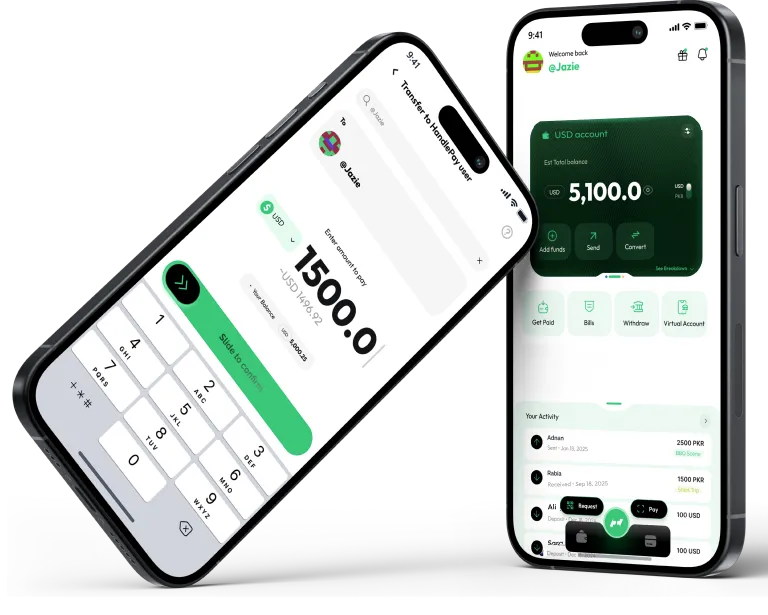
When you cash out from HandlePay to any Pakistani bank, pick the reason that matches your work: Purchase of services, Consulting fees, or Employee salaries or wages. Your bank then records the rupees under purpose code 9186, so you can get your PRC from your bank as usual. Use these reasons only for income from work for clients abroad.
Cash out is at the Google rate, and the rupees land within minutes. Our US account details, so US clients and platforms can pay you by ACH in your own name, are coming this month.
Claim your username today
Cash out to any Pakistani bank at the Google rate, within minutes, with your payment recorded as freelance services.
Sources
- Profit by Pakistan Today, "Pakistan's freelancer earnings hit record $1.76 billion in FY26" (SBP data), 21 Jul 2026
- Business Recorder, "IT exporters, freelancers laud govt's decision to maintain Final Tax Regime at 0.25%", 12 Jun 2026
- KPMG Taseer Hadi & Co., "A Brief of Finance Act, 2026", Jul 2026
- [WorldFirst South Asia, "Freelancers tax in Pakistan & Bangladesh: A complete guide [2026]", 2 Nov 2026](https://www.worldfirst.com/sasia/blog/freelancer-payments/freelancers-tax-south-asia/)
- State Bank of Pakistan, "State Bank of Pakistan Introduces New Measures to Facilitate IT Exporters and Freelancers", 6 Apr 2026
- NAB, "Pakistan Purpose of Payment codes" (SBP code list), checked 10 Nov 2026
- PSEB / Tech Destination, "How to register freelancers", checked 10 Nov 2026
- UBL, "UBL Freelancer Account", checked 10 Nov 2026
- Bank AL Habib, "PRC", checked 10 Nov 2026
- Taxation PK, "Meezan-Payoneer link automates ePRC for global earnings", 7 Mar 2025
- Elevate Pay, "PRC status", checked 10 Nov 2026
- Elevate Pay, "PRC for freelancers in Pakistan", 30 Apr 2026
- Elevate Pay, "9186 PRC certificate now available for NayaPay freelancers", 9 Jun 2026
FAQs
Is a PRC mandatory for freelancers in Pakistan?
Who issues the PRC, Payoneer or my bank?
What is the difference between purpose codes 9186 and 9471?
How much tax do freelancers pay with a PRC?
HandlePay Team
Our mission is to make international money work for everyday people, freelancers, and businesses in Pakistan.