You checked Google before your client paid: $1 = Rs 276.72. Then the money landed, you did the maths, and the rupees didn't match. At a 2% spread, $100 turns into Rs 27,119 instead of Rs 27,672, and no fee line on your statement explains the missing Rs 553.
If you've ever wondered why you get fewer rupees than the Google rate, this guide answers it with real rates from 19 October 2026: where the gap comes from, what it costs on $100, and a 30-second check to run before you convert anything.
Key takeaways
- Google's own disclaimer says to confirm rates before you transact. Treat its number as a reference, then check what your provider actually gives you.
- The gap between the rate you're shown and the rate you get is the spread. On $100, a 1% spread costs about Rs 277 and a 4% spread about Rs 1,107 (19 Oct 2026 rates).
- The "280" you hear quoted is usually the open market selling rate, the price of buying a dollar. When you sell dollars, you get the lower buying rate.
- To find your real rate, divide the rupees you received by the dollars sent. Compare it with Google at the moment you convert.
Why do I get fewer rupees than the Google rate?
Google doesn't trade currency. Its converter shows data provided by Morningstar, and Google's finance disclaimer says it can't guarantee the rates and that you should confirm current rates before making any transaction. So the number in the search box is a reference point. It tells you roughly what a dollar is worth in the wholesale market at that minute.
Your rupees come from somewhere else: the bank, platform or exchange company that actually converts your payment. Each of them sets its own buying rate. Three things push that rate below Google's:
- The spread. The provider's margin, built into the rate.
- Timing. Rates move during the day. If your payment is converted hours after you checked Google, you're comparing two different moments.
- Fees taken before conversion. A flat charge on a wire, or a withdrawal fee, shrinks the dollars before they're turned into rupees, so the rupee total drops even if the rate looked fair.
What is an exchange rate spread?
Every currency has two prices at once. Here is what USD to PKR looked like on Monday, 19 October 2026:
| Where | Buys your dollar at | Sells you a dollar at |
|---|---|---|
| A Pakistani bank, telegraphic transfer rate (Bank of Punjab) | Rs 276.90 | Rs 277.40 |
| Open market exchange companies | Rs 277.40 | Rs 280.35 |
| Mid-market reference (what converters like Google show) | Rs 276.72 | Rs 276.72 |
Two things stand out. First, the gap differs a lot by channel: half a rupee at a bank counter, nearly three rupees at an exchange company. Second, the mid-market figure has no gap at all, because it's a calculation, not a price anyone quotes you.
Payout platforms work the same way, but their spread is harder to see because they show you one rate, not two. Payoneer's fee page, for example, lists 1.2% to 4% for withdrawals that involve a currency conversion, and says its conversion rates include that fee.
Why is the dollar rate I hear higher than what I get?
This is where a lot of the "market is 280, they gave me 270" frustration starts. You hear 280, Google shows about 277, and your payout lands lower still. They're three different numbers:
- Rs 280.35 is what a money changer charged someone buying dollars.
- Rs 276.72 is the mid-market reference Google shows.
- Your rate is whatever your provider decided to give you, after its spread.
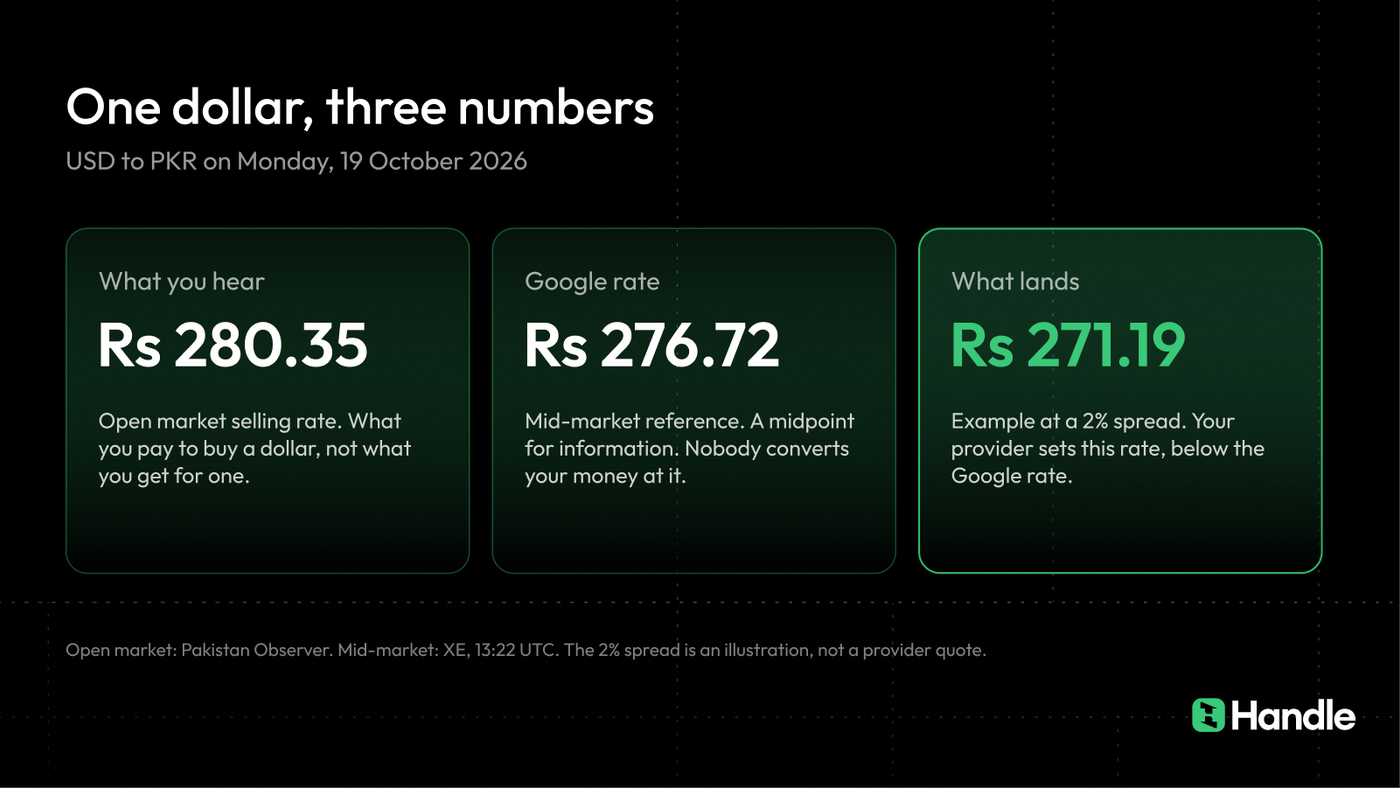
If someone gave you Rs 270 today, they took about 2.4% below the Google rate. On $100 that's Rs 672 you didn't get.
A worked example: what $100 turns into
Here's the same $100 payment converted at different spreads. The rate in each row is the mid-market rate minus that percentage.
| Spread below Google rate | Your rate | Rupees for $100 |
|---|---|---|
| 0% (mid-market) | Rs 276.72 | Rs 27,672 |
| 1% | Rs 273.95 | Rs 27,395 (Rs 277 lost) |
| 2% | Rs 271.19 | Rs 27,119 (Rs 553 lost) |
| 2.4% (the "they gave me 270" case) | Rs 270.00 | Rs 27,000 (Rs 672 lost) |
| 4% | Rs 265.65 | Rs 26,565 (Rs 1,107 lost) |
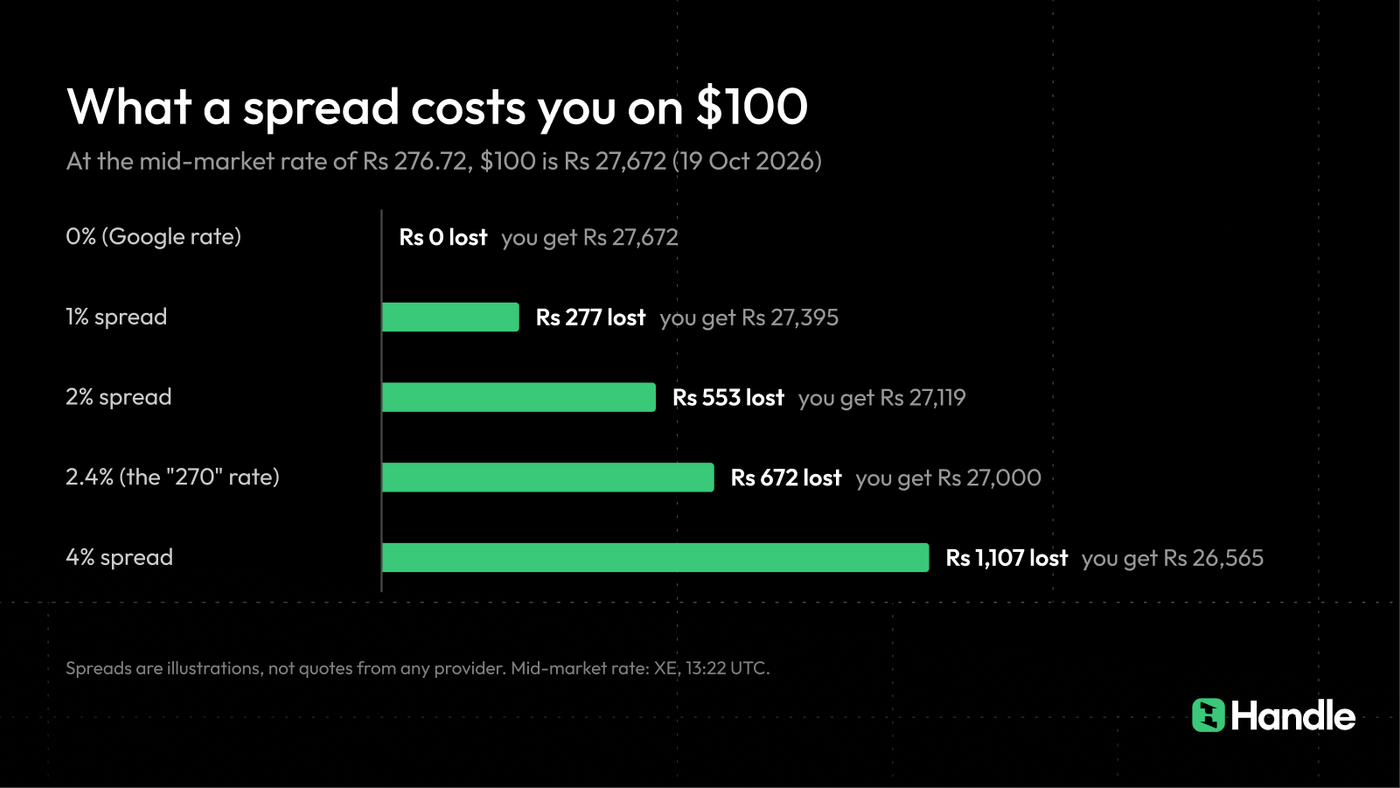
Small percentages add up because they hit every payment. If you're paid $1,000 a month and lose 2% each time, that's about Rs 66,400 a year at today's rate, money you earned and never received.
Watch for "zero fee" offers too. A provider with no fee line can still charge you through the rate. The only fair comparison is the number of rupees that land for the same dollars.
How can I see the rate before I convert?
Run this check every time. It takes under a minute.
Get the reference rate now
Search "USD to PKR" right before you convert, not in the morning. Note the number.
Get the rupee amount, not just the rate
Before you confirm, find the exact rupees you'll receive. If the screen only shows a rate, multiply it by your dollar amount yourself.
Work out your effective rate
Rupees received ÷ dollars sent. Example: Rs 27,119 ÷ $100 = Rs 271.19.
Turn it into a percentage
(Google rate − your rate) ÷ Google rate × 100. Example: (276.72 − 271.19) ÷ 276.72 × 100 = 2%.
Check fees separately
If dollars were deducted before conversion (a wire charge, a withdrawal fee), add them in. Tax deducted on export proceeds is its own line too, so don't mistake it for the rate.
If your payout platform converts automatically the moment money arrives, you can't run step 2 at all. You get whatever rate applied at that second. Holding the payment in dollars until you decide to convert puts the timing and the check back in your hands.
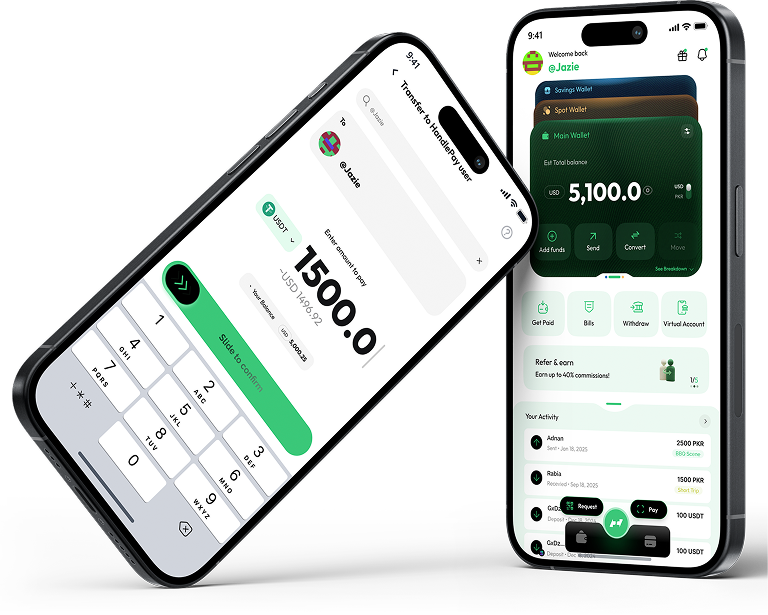
That's how HandlePay is built. Payments from abroad land in a dollar account in your own name and stay in dollars until you choose to convert to rupees.
Keep your dollars until you decide
Get paid from abroad into a dollar account in your own name, and convert to rupees when you choose.
Sources
- Google, Finance data listing and disclaimers (currency data provided by Morningstar)
- XE, USD to PKR mid-market rate, 13:22 UTC, 19 October 2026
- Business Recorder, Rupee records gain against US dollar, 19 October 2026
- The Bank of Punjab, foreign exchange rate sheet, 19 October 2026
- Pakistan Observer, Currency exchange rates in Pakistan today, 19 October 2026
- Payoneer, Fees, last updated 1 January 2026
FAQs
HandlePay Team
Our mission is to make international money work for everyday people, freelancers, and businesses in Pakistan.