You've signed the client. The work is done, or at least started. Then the email comes in: "Can you send over your payment details?" If you want to receive payment from a client abroad without a week of back and forth, the answer to that email matters more than which app you use. Send the wrong field, the wrong name or the wrong currency, and the money can sit in limbo or come back to the client.
Most guides stop at a list of apps. This one gives you the exact message to send, every field labelled, for a client in the US and one anywhere else. Everything below was checked on 24 October 2026.
Key takeaways
- A US client paying by ACH needs four things: your full legal name, a routing number, an account number and the account type.
- A client outside the US sends a SWIFT wire, which also needs a SWIFT code, the receiving bank's name and address, and your address.
- Ask for US dollars only. US account details are built to receive USD.
- The name on the payment must match your name exactly. A wrong account number is worse than a wrong name, so check every digit.
- A US client may also ask for Form W-8BEN. It goes to them, not to the IRS.
What details does a client abroad need to pay you?
Pakistani freelancers earned a record $1.76 billion in FY2025-26, up from $984 million the year before, according to State Bank of Pakistan data reported by Dawn. Every one of those payments needed the right details first.
The routing number is the one people get stuck on. It's a nine-digit number the American Bankers Association created to send payments to the right bank. With your account number, it tells your client's bank where the money goes.
| Field | US client (ACH or domestic wire) | Client outside the US (SWIFT wire) |
|---|---|---|
| Account holder name | Yes | Yes |
| Routing number | Yes | No |
| Account number | Yes | Yes |
| Account type | Yes (most ACH forms ask) | No |
| SWIFT code | No | Yes |
| Receiving bank name and address | Sometimes | Yes |
| Your address | Sometimes | Yes |
| Currency | USD | USD |
A message you can copy and send
Copy the version that matches your client, fill in the brackets from your app, and send it as it is. Every field is labelled, so their accounts team can type it straight into their payment form.
For a client in the US:
Hi [Client name],
Thanks for the go-ahead. Here are my payment details for invoice [number]:
Payment method: ACH (preferred) or domestic wire
Currency: USD
Account holder name: [Your full legal name, exactly as on your ID]
Routing number: [9 digits]
Account number: [Your account number]
Account type: [As shown in your app, usually checking]
Bank name: [As shown in your app]
Please put the invoice number in the payment reference. Let me know once it's sent and I'll confirm when it lands.
Thanks,
[Your name]
For a client outside the US:
Hi [Client name],
Here are my details for invoice [number]. Please send this as a SWIFT wire in US dollars:
Currency: USD (please don't convert to another currency before sending)
Beneficiary name: [Your full legal name, exactly as on your ID]
Beneficiary address: [Your address in Pakistan]
Account number: [Your account number]
SWIFT/BIC code: [As shown in your app]
Bank name and address: [As shown in your app]
Charges: OUR, so the full amount arrives
Reference: Invoice [number]
Thanks,
[Your name]
Save both as templates for the next client.
Should your client pay by ACH or wire?
ACH reaches every US bank and credit union account, so for your client it's a routine domestic payment. Nacha, which runs the network, puts the share settling in one banking day or less at about 80%, and Same Day ACH can carry up to $1 million per payment.
A SWIFT wire often passes through intermediary banks, and they can take a fee out of the amount sent. That's why the second message asks for "OUR" charges. UK bank NatWest explains the three options: with OUR the sender pays all charges and the full amount arrives; with SHA the charges are shared; with BEN the person receiving the money pays them, so you get less than was sent.
| Compare | ACH | SWIFT wire |
|---|---|---|
| Who can send it | Clients with a US bank account | Clients almost anywhere |
| What they need from you | Name, routing number, account number, account type | Name, address, account number, SWIFT code, bank name and address |
| Typical speed | Most settle in one banking day or less | Varies with the number of banks in between |
| Watch out for | Name and account number typos | Fees taken by intermediary banks; ask for OUR |
If you're still choosing how to get paid at all, we compared every route by payer in freelancer payment methods in Pakistan.
Why should only USD go to US account details?
Clients outside the US get this wrong most often, because their banking app may default to their home currency. Write "Currency: USD" in the message, put the amount in dollars on the invoice, and ask them not to convert before sending. Whoever converts your payment picks the rate, and the gap comes out of your money. We showed how much that gap costs in why you get fewer rupees than the Google rate.
What to do if your client pays under a different name
When your name is wrong on the payment. Your US account details are in your own name, so the payee name should match it exactly: no nickname, no shortened surname, no business name. If "Muhammad Ali Khan" becomes "Ali Khan" or "M. Khan Designs," the payment can be held or returned. Check the payee name in their payment form before they hit send, not after.
When the account number is wrong, it's worse. Under US wire transfer law (UCC Article 4A, section 207), a receiving bank that doesn't know the name and number belong to different people may rely on the account number alone. In other words, a wire with your name and someone else's account number can go to that someone else. Read the number back to your client, digit by digit, on the first payment.
When the payer's name is different from your client's. Plenty of clients pay through a parent company, a payroll provider or an accounting firm. Your contract says "Brightline LLC" and the payment arrives from "Brightline Holdings." That's normal. Keep the contract, the invoice and any email that shows who pays you, in case you're ever asked where a payment came from.
When someone else's client wants to pay you. Don't take it. Your brother's client should pay your brother. We covered who a USD account fits in who needs a USD account.
Will a US client ask you for tax forms?
The IRS page for Form W-8BEN says to give it "to the withholding agent or payer if you are a foreign person." Your client's accounts team keeps it on file. Use the same name on the W-8BEN, your invoice and your US account details. We're not tax advisers, so for questions about tax treaties or your own filing, talk to one.
How to make the first payment go smoothly
Get your details ready before you invoice
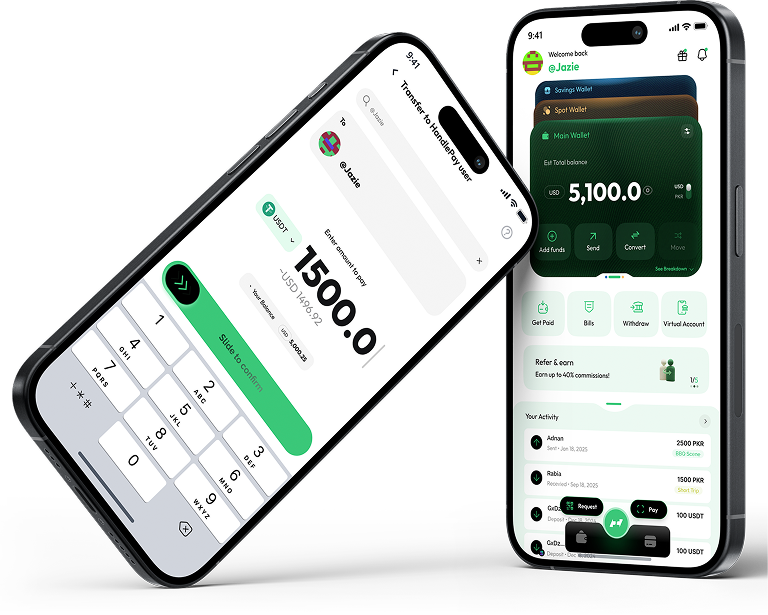
In HandlePay, you verify your identity once, request your USD account and copy your US account details from the app.
Send the right message
ACH for a US client, SWIFT for everyone else.
Invoice in USD, in your legal name, with the reference you want them to use
Check the payee name and account number in their payment form before they send
A screenshot is fine.
Confirm when it lands
Once the money is in, it stays in dollars until you decide to convert. When you want rupees, you cash out to any Pakistani bank in your name, and only you can move your money.
Get US account details in your own name
Send your client one message, get paid by ACH or SWIFT in USD, and cash out to PKR when you choose.
Sources
- Dawn, "Freelancers earn $1.76bn", 21 Jul 2026
- American Bankers Association, "ABA Routing Number", checked 24 Oct 2026
- Nacha, "How ACH Payments Work", checked 24 Oct 2026
- Nacha, "The ABCs of ACH", checked 24 Oct 2026
- NatWest, "International payments" (OUR, SHA and BEN charge options), checked 24 Oct 2026
- Chase, "What are wire transfer fees?" (intermediary bank fees), checked 24 Oct 2026
- Cornell Law School LII, UCC § 4A-207, "Misdescription of beneficiary"
- IRS, "About Form W-8BEN" (last reviewed 2 Oct 2026)
- State Bank of Pakistan, BPRD Circular No. 05 of 2023, Framework for Freelancers Accounts
FAQs
HandlePay Team
Our mission is to make international money work for everyday people, freelancers, and businesses in Pakistan.