A client in New York wants to pay you $500. Before they can, you need to tell them how. Search "how to receive USD in Pakistan" and most results are written for families sending money home, not for someone getting paid for their work.
This guide compares every real option in 2026 on three things. Can your payer use it? What do you keep from a $500 payment? Does your money stay in dollars, or get turned into rupees for you?
Key takeaways
- There are six main routes: a freelancer bank account, Payoneer, a dollar account in your own name, Wise, remittance apps, and crypto. PayPal still doesn't offer accounts to people living in Pakistan.
- Your client's payment method decides most of it. US clients prefer ACH, which local Pakistani bank accounts can't receive.
- Since April 2026, banks must let freelancers keep at least $5,000 a month or 50% of export proceeds (whichever is higher) in a dollar account.
- Tax applies whichever route you use: 0.25% for PSEB-registered IT exporters, 1% otherwise.
What are the ways to receive USD in Pakistan?
Here's each one in plain terms.
1. Freelancer bank account (ESFCA)
An ESFCA (Exporters' Special Foreign Currency Account) is a dollar account that Pakistani banks open for exporters and freelancers to hold export earnings. Under the State Bank of Pakistan's freelancer framework, you can open one alongside a rupee account, in person or online. Your client sends a SWIFT wire to your IBAN.
Since April 2026, banks must keep $5,000 a month or 50% of your export proceeds in the dollar account, whichever is higher, unless you ask for less (The News, 7 April 2026). They must also process inward export receipts within one working day, and you only fill a Form R for payments above $25,000.
The catch is that local bank accounts receive wires, not ACH. ACH is the US domestic bank transfer network, the cheap default for US businesses and payroll tools. Wires also pick up sender, intermediary and receiving charges along the way.
2. Payoneer
Payoneer is the default for Upwork and Fiverr, and it can also give you receiving details for direct clients. Payoneer's fee page (updated 1 January 2026) lists 1% to receive into an account in a currency that isn't your local one. Withdrawing to a bank with currency conversion costs 1.2% to 4%, and there's a $29.95 annual fee if you receive less than $6,000 in any 12 months.
3. A dollar account in your own name
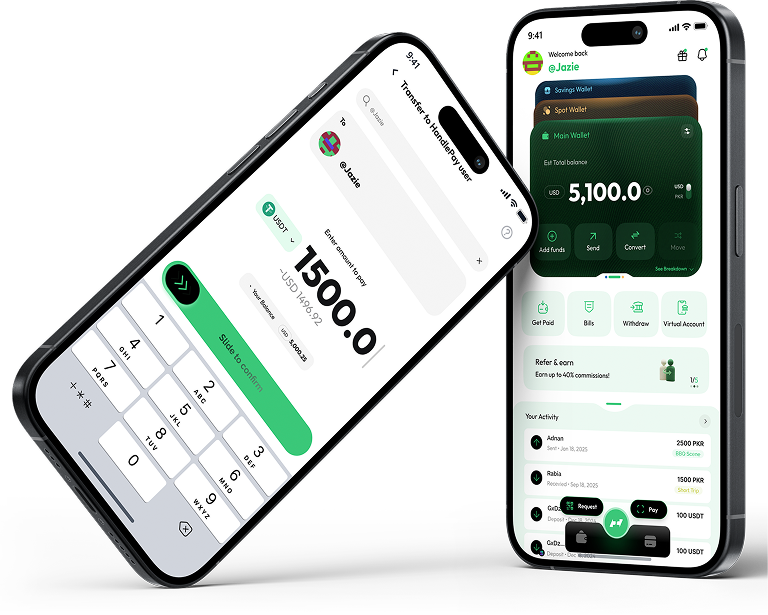
A dollar account is an account that holds US dollars and comes with US account details (account and routing number) in your own name. Dollar account apps give you one, so a US client pays you the way they'd pay anyone in America, by ACH or wire. HandlePay is one of them. The money lands in dollars and stays in dollars until you choose to convert and withdraw to your Pakistani bank.
4. Wise
Wise works in Pakistan for sending and converting money, but its local receiving details for USD are limited to residents of certain countries. Most Pakistan-based freelancers can't use it to receive client payments. Check wise.com for your situation before you give it to a client.
5. Remittance apps
Western Union, Remitly, Xoom and similar apps are built for family sending money home. The money usually arrives in rupees, not dollars, and they aren't meant for client invoices. Since 1 July 2026 the State Bank no longer reimburses banks for these transfers, but it has told them to keep eligible home remittances free for customers (Khaleej Times).
6. Crypto and stablecoins
Some freelancers ask clients to pay in stablecoins. It's fast, and Pakistan's parliament passed the Virtual Assets Act on 6 March 2026, which requires crypto service providers to be licensed by the Pakistan Virtual Assets Regulatory Authority. The risk sits at the cash-out step: converting through peer-to-peer traders can expose your bank account to fraud-linked funds and freezes.
How can I receive money from the USA in Pakistan?
Match the route to the payer:
| Who is paying you | How they usually pay | What you need |
|---|---|---|
| US client or company | ACH bank transfer | US account details (dollar account or Payoneer) |
| Client outside the US | SWIFT wire | Freelancer bank account (ESFCA) or US account details that accept wires |
| Upwork | Direct to U.S. Bank, Payoneer or wire | US account details or Payoneer |
| Fiverr | Payoneer | Payoneer |
| Family in the US | Remittance app | Any Pakistani bank account or mobile wallet |
One change to note: since 1 September 2026, Upwork charges freelancers outside the US $2.99 per Direct to U.S. Bank withdrawal.
What is the best way to receive payment from abroad in Pakistan?
There's no single winner for everyone. The right answer depends on three questions:
- Can your payer use it? A route your client can't pay into is useless, however cheap it is.
- What do you keep? Add up every fee and the exchange rate, not just the headline fee. Our guide on why you get fewer rupees than the Google rate shows how to work out the rate you really got.
- Who decides when you convert? Some routes convert to rupees on arrival. Others let you hold dollars and convert when the rate suits you.
Which options keep your money in dollars?
| Option | Keeps your money in dollars? | Paid out in |
|---|---|---|
| Freelancer bank account (ESFCA) | Partly: $5,000 a month or 50% of proceeds, whichever is higher | Dollars (part) and rupees |
| Payoneer | Yes, until you withdraw to a Pakistani bank | Rupees when withdrawn |
| Dollar account app (like HandlePay) | Yes, until you choose to convert | Dollars until you convert |
| Wise | Not available to receive for most Pakistan residents | n/a |
| Remittance apps | No | Usually rupees |
| NayaPay, SadaPay and other wallets | No | Rupees |
Why it matters: when your income converts on arrival, you take whatever rate applies that day. Holding dollars lets you choose your moment, and protects savings from the rupee falling.
What does each option cost on a $500 payment?
Here's what's published for a $500 client payment:
| Option | Fees you can check | Tax on $500 |
|---|---|---|
| Freelancer bank account | Sender, intermediary and receiving bank charges vary; ask your bank. Conversion at the bank's rate on the rupee part | $1.25 (PSEB) or $5 |
| Payoneer | $5 to receive into a non-local-currency account (1%); $6 to $20 to withdraw with conversion (1.2% to 4%); $29.95 a year if under $6,000 in 12 months | $1.25 (PSEB) or $5 |
| Dollar account app (HandlePay) | A conversion fee on receipt (see current pricing in the app) | $1.25 (PSEB) or $5 |
| Upwork Direct to U.S. Bank | $2.99 per withdrawal from Upwork, then your account's own fees | $1.25 (PSEB) or $5 |
Worked example: $500 from a US client through Payoneer
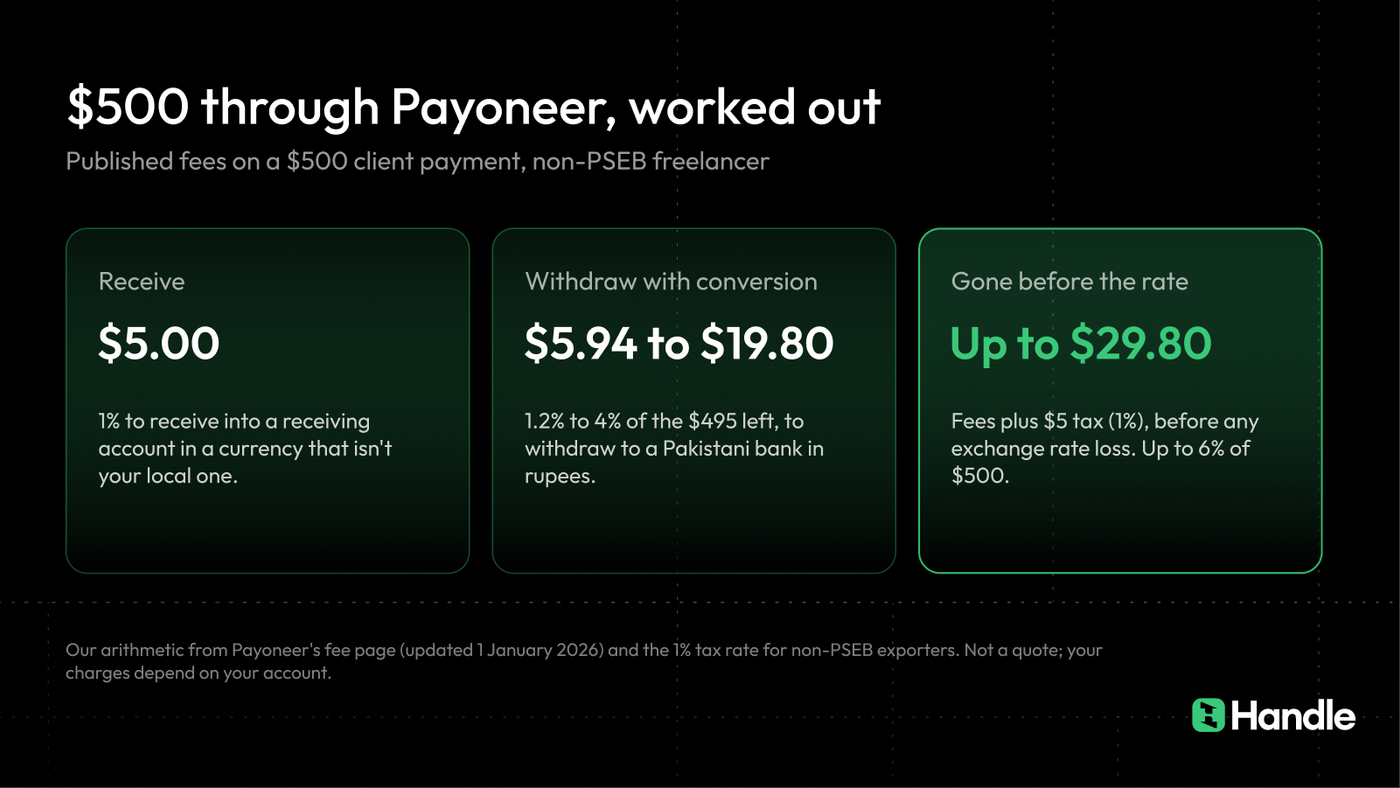
Here's what the published fees add up to for a non-PSEB freelancer who withdraws to a Pakistani bank, using Payoneer's own percentages:
- Receive $500 into a non-local-currency receiving account: 1% = $5.00, leaving $495.00.
- Withdraw with conversion at 1.2% to 4%: $5.94 to $19.80, leaving $489.06 to $475.20.
- Tax at 1% on the $500: $5.00.
That's $15.94 to $29.80 gone from a $500 payment (3.2% to 6.0%) before the exchange rate is even counted, and the $29.95 annual fee comes on top if you earn under $6,000 a year through it. This is our arithmetic from Payoneer's fee page, not a quote; your actual charges depend on your account.
The cheapest route on paper can still cost you the most if it converts at a poor rate. Always compare the final rupees, or dollars, that land for the same payment. If you've ever wondered where the missing money goes, read the hidden tax Pakistani freelancers pay.
Can I receive USD in NayaPay?
The same applies to SadaPay and other mobile wallets: they're useful for spending rupees, not for receiving and holding dollars.
How to set up a dollar account to receive USD
If your clients are in the US, this is the quickest way to get paid like a local:
Download the app
Claim your username and secure your account with Face ID or your fingerprint.
Open your dollar account
Verify your identity once, and you get US account details in your own name.
Send your details to your client
They pay by ACH or wire, exactly as they would pay a US contractor.
Get paid in dollars
The money stays in dollars, in your name, until you decide to convert.
Withdraw to PKR when you choose
Send it straight to any Pakistani bank.
For a fuller walk-through of how this compares with wires and Payoneer, read a new way for freelancers to get paid in Pakistan.
Get paid like a US contractor
Open a dollar account in your own name, give your client US account details, and keep your earnings in dollars until you decide.
Sources
- State Bank of Pakistan, Framework for Freelancers Accounts (BPRD Circular No. 05 of 2023)
- The News, SBP launches new measures to boost IT exports, 7 April 2026
- Payoneer, Fees, last updated 1 January 2026
- Self Employed, Upwork adds $2.99 withdrawal fee for freelancers outside the US, 4 September 2026
- Khaleej Times, Will remitting money from UAE to Pakistan cost more, 12 July 2026
- Arab News, Pakistan passes Virtual Assets Act 2026, 6 March 2026
- NayaPay Help, Transfer money from Payoneer to NayaPay
- URCA, Pakistan withholding tax rate card 2026-27
FAQs
HandlePay Team
Our mission is to make international money work for everyday people, freelancers, and businesses in Pakistan.