If you want to receive a SWIFT payment in Pakistan, getting the details right takes five minutes. Knowing what will arrive takes more work. A $1,000 SWIFT transfer can pass through one or two banks before it reaches yours, and each one can take a cut. Then your bank decides the rate when the dollars become rupees.
Three numbers to keep in mind, checked on 18 November 2026:
- 1 to 5 working days. WorldFirst's July 2026 guide gives this range for most international transfers to Pakistan. Each extra bank in the chain can add 1 to 2 days.
- $5,000 or 50%. Under State Bank rules, freelancers can keep $5,000 a month or 50% of their export income in dollars, whichever is higher, in a freelancer foreign currency account.
- $25,000. Under State Bank rules announced in April 2026, export proceeds up to $25,000 don't need a separate declaration, Profit reported.
Key takeaways
- Give your client four things: your account title, IBAN, SWIFT code and your bank's name and address.
- OUR means your client pays every bank charge. SHA and BEN mean some or all of it comes out of your payment.
- Bank charges along the way are the cost you don't see coming. Ask for OUR on the first payment and compare what lands.
- A SWIFT payment into a freelancer account keeps part of it in dollars. The rest is converted at your bank's rate.
- US clients have a cheaper option than SWIFT: ACH.
What details do I need to receive a SWIFT payment in Pakistan?
Here's what to send, and where to find it:
| Detail | What it looks like | Where to find it |
|---|---|---|
| Account title | Your name, spelled exactly as on your bank record | Bank app, cheque book or statement |
| IBAN | 24 characters, starting with PK | Bank app or statement |
| SWIFT code (BIC) | 8 or 11 letters and numbers | Your bank's website or branch |
IBAN length from UBL's IBAN guide. BIC format from Swift.
Two things often go wrong. The first is a name that doesn't match. If your client types "M. Ali" and your bank has "Muhammad Ali Khan", the payment can be held or sent back. We covered the fixes in why a USD payment gets returned.
The second is the currency. If your client's bank converts pounds or euros into dollars before sending, they choose the rate, not you. Ask them to pay in USD from a USD balance if they have one.
Also ask your client to add a short reference, such as "Payment for design services, invoice 104". It helps your bank code the payment as income for your work, which matters later for your PRC.
Who pays SWIFT charges: OUR, SHA or BEN?
The three options, as UOB Singapore explains them on its remittance help page:
| Charge option | Who pays | What you receive on $1,000 |
|---|---|---|
| OUR | Your client pays every bank's charge | $1,000, unless a bank in between still deducts a fee |
| SHA (shared) | Your client pays their own bank; you pay the banks in between and your own bank | $1,000 minus the charges of the banks in between and your bank |
| BEN | You pay every bank's charge, including your client's bank | $1,000 minus all of the charges along the way |
UOB, Remittances FAQ, checked 18 November 2026. Each bank sets its own charges, so the exact amounts depend on the route.
Even with OUR, a payment can still arrive a little short. UOB's own FAQ says it isn't liable if a correspondent or the receiving bank doesn't follow the charge instructions. That's why the first payment matters. Ask your client for the amount sent, compare it with what lands, and you'll know what that route costs.
If you invoice $1,000 and want $1,000, put "Please send with OUR charges" on the invoice.
How long does a SWIFT transfer take to reach Pakistan?
Swift's own figures show how fast the network can be: 40% of gpi payments credited within 30 minutes, and 92% within 24 hours, it said in October 2020. Real payments to Pakistan are often slower, for a few reasons:
- Banks in between. A USD payment often passes through one or more correspondent banks. WorldFirst says each one can add 1 to 2 business days.
- Cut-off times. Banks send international payments in batches. Miss today's batch and the payment waits for tomorrow's.
- Weekends and holidays. A Friday payment from the UK can sit until Monday, and Pakistani bank holidays add more.
- Checks at your bank. Your bank may ask what the payment is for before it credits your account, especially on a first payment.
If a payment is late, ask your client for the MT103, the bank's proof that the payment was sent. It carries a reference your bank can trace.
Should my client use SWIFT or ACH?
ACH is the US's domestic bank network. A Pakistani IBAN can't receive it. US account details in your own name can, and then a US client pays you like any local supplier. We explained how in how to receive ACH payments in Pakistan.
For clients outside the US, SWIFT is still the main route. Here's where a $1,000 SWIFT payment can land:
| Where the SWIFT payment lands | Rate when you get rupees | Fees on $1,000 |
|---|---|---|
| Pakistani bank, freelancer foreign currency account | Your bank's rate, on the part it converts | Charges of the banks along the way (by OUR, SHA or BEN), plus your bank's own charges. Keeps $5,000 a month or 50% in dollars, whichever is higher |
| Pakistani bank, rupee account | Your bank's rate on the day it lands | Same bank charges. Converted to rupees on arrival |
| HandlePay US account details (SWIFT) | The Google rate, when you cash out | $20 flat plus 0.2%, so $1,000 lands as $978. Then 0.4% when you cash out to rupees |
State Bank retention rule as reported by Profit, 6 April 2026. HandlePay fees from handlepay.io/fees, checked 18 November 2026. Pakistani banks publish their own charges in their schedule of charges.
To see what your bank's rate costs you, divide the rupees that landed by the dollars that arrived, then compare it with the day's rate on our USD to PKR page.
Can I keep a SWIFT payment in dollars in Pakistan?
On a single $1,000 payment, that rule lets you keep all of it in dollars, since you're under $5,000 for the month. Over $10,000 in a month, half gets converted. Profit's summary of the April 2026 rules also says money in these accounts can pay for software subscriptions, foreign consultancy and overseas vendors, but can't be moved to other foreign currency accounts.
If you want all of it in dollars, you need somewhere outside your Pakistani bank to receive it. That's what a dollar account in Pakistan with US account details is for: you choose when to convert, and how much.
How do I make sure a SWIFT payment counts as freelance income?
The code matters at tax time. Export income from IT services is taxed at a 0.25% final rate if you're registered with PSEB, or 1% if you're not. A payment coded as a home remittance won't count as export income, and it's hard to fix afterwards. Our guide to getting a PRC as a freelancer explains what to ask your bank for.
Where HandlePay fits
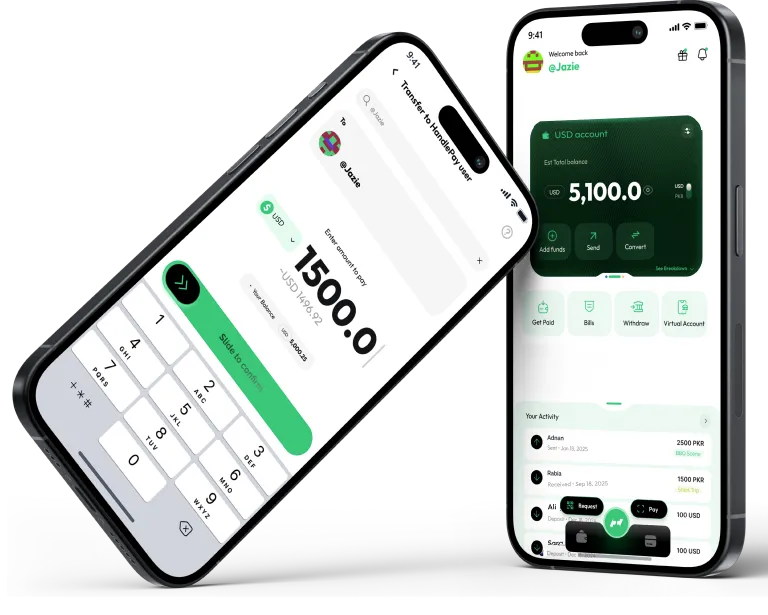
HandlePay gives you US account details in your own name, for clients who pay by ACH or SWIFT. Clients outside the US send USD by SWIFT for a flat $20 plus a 0.2% conversion fee, and it arrives in 3 to 4 days. A $1,000 payment lands as $978. The payer's bank, or a bank in between, may take its own charge first, so OUR still helps.
US clients pay by ACH instead, for 0.7%, within 24 hours. Either way, your money stays in dollars until you cash out to any Pakistani bank at the Google rate, for 0.4%, within minutes. Cashing out $978 that way comes to about Rs 269,000 at the State Bank's 17 November rate of Rs 276.25. There's no cash-out limit, and the USD account is free for the first year. Every fee is on our fees page.
When you cash out, pick the reason that matches your work, such as Purchase of services or Consulting fees, and your bank records the rupees under purpose code 9186.
Get US account details in your own name
Get paid by ACH or SWIFT, keep it in dollars, and cash out to any Pakistani bank at the Google rate when you choose.
Sources
- WorldFirst, "International Money Transfer Times in South Asia: How Long Do Global Payments Take in 2026?", 7 Jul 2026
- Profit by Pakistan Today, "SBP eases export reporting rules to boost IT sector growth", 6 Apr 2026
- Swift, "Swift gpi driving payments revolution", 7 Oct 2020
- UOB, Remittances FAQ (OUR, SHA and BEN), checked 18 Nov 2026
- UBL, International Bank Account Number FAQs, checked 18 Nov 2026
- Swift, "Business Identifier Code (BIC)", checked 18 Nov 2026
- State Bank of Pakistan, "Weighted Average Customer Exchange Rates", 17 Nov 2026
- HandlePay, Fees, checked 18 Nov 2026
FAQs
What is a SWIFT code in Pakistan?
Do I need an IBAN to receive money from abroad in Pakistan?
Why did I receive less than my client sent?
How do I track a SWIFT payment to Pakistan?
Is SWIFT or ACH cheaper for Pakistani freelancers?
HandlePay Team
Our mission is to make international money work for everyday people, freelancers, and businesses in Pakistan.