Most are fixed with one message once you know which went wrong. This guide is written for the receiving side: a freelancer or remote worker in Pakistan waiting on a payment that never arrived.
Three numbers set the timeline:
- 2 banking days: the window a US bank has to return most ACH payments for account errors, under Nacha rules as Column Bank's documentation sets them out.
- 5 to 15 business days: how long a returned SWIFT wire typically takes to get back to the sender, according to Xe (20 February 2026).
- No name check required: Nacha's rules let the receiving bank post an ACH payment on the account number alone (ACH Operations Bulletin #2-2024, 22 July 2024).
The ACH network carried 35.2 billion payments worth $93 trillion in 2025, Nacha reported on 28 January 2026. Returns are a tiny share of that. When yours is one of them, though, the wait lands on you.
Key takeaways
- The name on the payment should match the name on your US account details exactly: no nickname, no business name, no shortened surname.
- A wrong account number is worse than a wrong name. US banks may rely on the number alone, so a typo can bounce your money or send it to a stranger.
- Only USD should go to US account details. A pound or dirham payment can be converted on the way in, then converted again if it's returned.
- A returned wire can come back short. ACH usually returns the full amount.
- Get the return reason before anyone resends.
Why was my USD payment returned?
For an ACH payment, the US bank sends it back with a short code. These are the ones you're most likely to meet on a payment to you:
| Return code | What it means | What to do |
|---|---|---|
| R03: No account / unable to locate account | The number doesn't match an account, or doesn't belong to the person named on the payment | Check the name and account number against your details, digit by digit |
| R04: Invalid account number structure | The number isn't in a valid format, usually a typo | Send your details again as text your payer can copy, not a screenshot |
| R02: Account closed | The account the payer has on file was closed | Make sure they're using your current details, not an old number |
| R16: Account frozen | The bank or a legal action restricted the account, or the payment was returned on US sanctions (OFAC) instruction | Talk to whoever holds your account before asking for a resend |
| R17: Can't be processed | A field couldn't be processed, or the account number looked invalid in a suspicious way | Ask the payer to re-enter your details from scratch |
| R23: Credit refused by receiver | The account holder refused the payment and their bank sent it back | Find out who refused it and why |
Descriptions from Goldman Sachs Transaction Banking and Column Bank developer documentation, checked 2 November 2026.
Wires don't carry these codes, but HSBC lists the same reasons for rejected transfers and says "the receiving bank makes the final decision on whether to accept the funds."
What happens if the name doesn't match on an ACH payment?
Nacha's July 2024 bulletin puts the rule in one line: "The Nacha Rules permit an RDFI to rely solely on the account number when posting an Entry." The RDFI is the bank receiving the money. The same bulletin says a name comparison "can help determine the validity of an Entry" when something looks off, which is why plenty of banks check anyway.
In practice, a small difference may get through, but don't count on it. "Muhammad Ali Khan" typed as "M. Ali Khan" can post at one provider and come back at another. A business name on a personal account is the riskier case: if your details are in your own name and your client pays "Khan Designs," expect trouble.
Platforms are stricter than banks. Upwork's help centre says your verified name "must match the name on any bank accounts or withdrawal methods you intend to use," and warns that a wire could be "rejected or delayed by the receiving bank" if it doesn't.
Can a wire transfer be returned for a name mismatch?
The rule is UCC Article 4A, section 207(b): if the beneficiary's bank doesn't know the name and number refer to different people, it "may rely on the number as the proper identification of the beneficiary." It doesn't have to check that they match.
A wrong name usually gets a wire held or returned. A wrong number can deliver it to a stranger. On the first payment from any new client, read the number back together.
How long does a returned payment take to come back?
| ACH payment | SWIFT wire | |
|---|---|---|
| Who sends it back | The receiving US bank, with a return code | Each bank on the route, back the way it came |
| Typical return time | Most account errors within 2 banking days | Typically 5 to 15 business days |
| Can it come back short? | Rarely: the original amount goes back | Yes: fees along the way, and converted again at a new rate |
ACH return windows from Column Bank; wire return times from Xe (20 Feb 2026); wire fees and conversion from HSBC. Checked 2 November 2026.
Some ACH returns have no fixed deadline. A credit refused by the receiver (R23) can come back days later, after a review. If a week has passed and nobody can tell you where the money is, ask your payer to request a trace from their bank.
Do you lose money when a payment is returned?
HSBC also says transfer fees "are generally not refundable."
Sending the wrong currency hurts twice here. Say a client in Dubai sends dirhams to your US account details. A bank converts them to dollars at its own rate on the way in. If the payment is returned, it's converted back at a new rate, and neither rate is the one you see on Google. We worked through what that gap costs in why you get fewer rupees than the Google rate.
You aren't paid until a new payment lands, so agree with your client who covers any wire fees before they resend.
What should you tell your payer?
A message you can copy and adapt:
Hi [name], thanks for letting me know the payment came back. Could you share the return reason or code your bank gave you? Here are my details again so the next one goes through. Please copy them exactly:
- Name: [your full name, exactly as on your account]
- Account number: [number]
- Routing number: [number] (for ACH)
- SWIFT code: [code] (for international wires)
- Currency: USD only, please
From a US account, ACH works best. From outside the US, please send a SWIFT wire in USD with OUR charges, so no fees come out of the amount. Could you read the account number back to me before you send? Thanks!
Paid through a platform instead of a client? The same logic applies to your withdrawal method: your verified name and the name on the method must match. For every detail a client needs on the first payment, see how to receive payment from a client abroad.
How to stop it happening again
- Use one legal name everywhere: account, invoice, contract, W-8BEN and platform profile.
- Send details as copyable text. Retyping from a screenshot is where a 7 becomes a 1.
- Ask every new payer for a read-back. One minute on WhatsApp beats two weeks waiting for a wire to come home.
- Put "Currency: USD" on every invoice. Clients outside the US often default to their own currency.
- Match the method to the payer: ACH for US payers, SWIFT for everyone else. We explained routing numbers and ACH in how to receive ACH payments in Pakistan.
- When you leave a provider, update every client and platform so nobody pays a closed account.
Where HandlePay fits
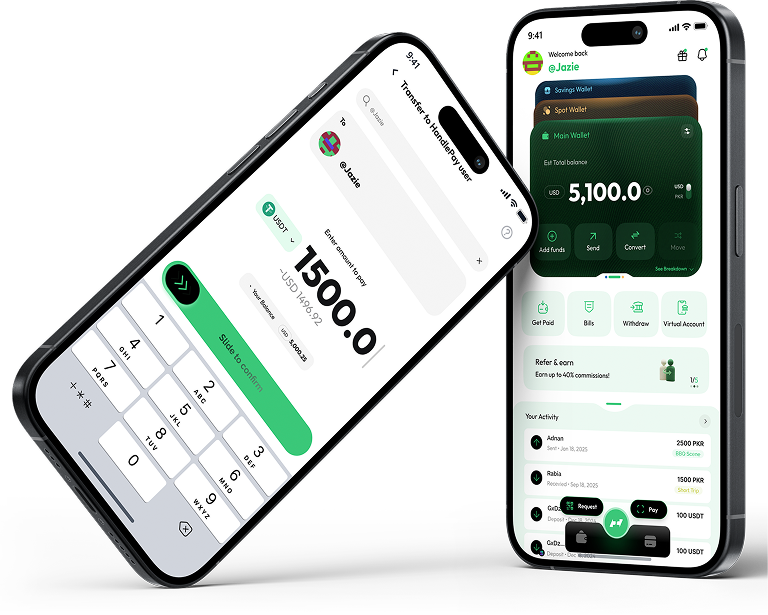
We're building US account details in your own name, so the name your client types is the name on the account. They aren't open yet. Today, HandlePay lets you send money free to any HandlePay user and cash out to any Pakistani bank at the Google rate, within minutes.
Claim your username today
Send money free between HandlePay users and cash out to any Pakistani bank at the Google rate. Be set up the day US account details open.
Sources
- Nacha, "ACH Operations Bulletin #2-2024: Voluntary Formatting Standard for Individual Name Field", 22 Jul 2024: https://www.nacha.org/news/ach-operations-bulletin-2-2024-voluntary-formatting-standard-individual-name-field
- Nacha, "Same Day ACH and Business-to-Business Payments Propel ACH Network Volume Growth in 2025", 28 Jan 2026: https://www.nacha.org/news/same-day-ach-and-business-business-payments-propel-ach-network-volume-growth-2025
- Column, "ACH Returns" (developer documentation), checked 2 Nov 2026: https://docs.column.com/ach/returns
- Goldman Sachs Transaction Banking, "ACH Return Codes", checked 2 Nov 2026: https://developer.gs.com/docs/services/transaction-banking/ach-return-codes/
- Cornell Law School LII, UCC § 4A-207 "Misdescription of Beneficiary", checked 2 Nov 2026: https://www.law.cornell.edu/ucc/4A/4A-207
- HSBC Singapore, "Worldwide Transfers FAQ", checked 2 Nov 2026: https://www.hsbc.com.sg/foreign-exchange/worldwide-transfers/faq/
- Xe, "Returned International Payment Playbook: 7 Steps to Recover Funds and Resend Correctly", 20 Feb 2026: https://www.xe.com/blog/business/returned-international-payment-playbook-7-steps-to-recover-funds-and-resend
- Upwork Help, "What to do if your Upwork account and withdrawal method are under different names", checked 2 Nov 2026: https://support.upwork.com/hc/en-us/articles/211063768-What-to-do-if-your-Upwork-account-and-withdrawal-method-are-under-different-names
FAQs
HandlePay Team
Our mission is to make international money work for everyday people, freelancers, and businesses in Pakistan.