The benefits of a dollar account are easiest to see from the other side. You finish a project, the client pays $1,000, and what reaches you is a rupee figure someone else decided. Or the one app you get paid through changes its fees overnight. Or a new US client asks for your routing number and you don't have one.
None of these feel like a big deal until they happen to you. This post goes through what goes wrong without a dollar account, what one fixes, and the cases where you don't need it. Everything below was checked on 25 October 2026.
Key takeaways
- A dollar account lets you receive US dollars in your own name and decide when to turn them into rupees.
- Without one, your payment is usually converted for you, at a rate the bank or app picks.
- Relying on one payout app is a risk. Its terms let it change fees, restrict withdrawals or close accounts.
- US clients and platforms like Upwork pay by ACH, which needs US account details.
- If you're paid in rupees, or you always convert straight away at a good rate, you may not need one.
What are the benefits of a dollar account?
Pakistani freelancers earned a record $1.76 billion in FY2025-26, up from $984 million the year before, according to State Bank of Pakistan data reported by Dawn. Every one of those payments had to answer three questions: whose exchange rate, which payout route, and which account details.
Here is what each one looks like with and without a dollar account:
| Method / Platform | Without a dollar account | With a dollar account |
|---|---|---|
| Exchange rate | Your payment is converted when it lands, at the bank's or app's rate | Your money stays in dollars until you choose to convert |
| Payout route | One app or platform holds your income | Clients can pay you directly, so you have a second route |
| Client asks for US details | You send a SWIFT request or ask them to use another platform | You send a routing number and account number in your name |
| Rupee moves | You take whatever the rate is on payday | You convert when the rate suits you |
What happens when your payment is converted to rupees for you?
On Friday 23 October 2026, the State Bank of Pakistan's interbank rate closed at Rs 276.82 per dollar. Nobody selling dollars as a freelancer gets that exact rate. Banks and payout apps add a margin, called a spread, and the rupee figure that lands in your account is what's left.
Here's what that looks like on one payment:
| $1,000 converted at | You receive | Difference |
|---|---|---|
| Interbank (Rs 276.82) | Rs 276,820 | |
| Interbank minus 2% | Rs 271,284 | Rs 5,536 less |
We broke this down rate by rate in why you get fewer rupees than the Google rate.
The second cost is timing. The rupee doesn't sit still. On 22 August 2023, it hit a then-record low of Rs 299.01 per dollar in the interbank market, according to SBP data reported by Profit. Today it's around Rs 277. At interbank rates, $1,000 converted in October 2026 buys about Rs 22,000 less than it did in August 2023. Nobody can call these moves in advance. With a dollar account you still can't, but payday no longer decides your rate for you.
A freelancer account at a Pakistani bank helps here too. Under the State Bank's rules, reconfirmed in April 2026, freelancers can keep 50% of their export proceeds or $5,000 a month in dollars, whichever is higher. Above that, the bank converts the rest to rupees.
What if your only payout route closes your account?
You'll find this in the terms of any payment company. Payoneer's terms (the April 2026 version for Payoneer Inc.) say it "may close, suspend, or limit your access to your use of the Payoneer Services and/or limit access to your funds." That's standard wording, and it's why depending on one route is a weak spot.
Fees can change just as quickly. In May 2025, The Express Tribune reported that Payoneer had quietly introduced new fees for Pakistani users: 1% on incoming USD payments over $100, $1 on smaller ones, and a flat 3% on withdrawals to non-rupee bank accounts. If that was your only route, you paid the new fees or stopped getting paid.
And some routes never open at all. PayPal still has no direct operations in Pakistan, as ProPakistani noted in May 2026, when PayPal launched in Sri Lanka instead.
Keep the apps you already use, and make sure you're never down to one. With US account details in your own name, any client with a US bank account can pay you directly, whatever happens to a platform.
Why do clients and platforms ask for US account details?
To a US accounts team, an ACH payment is the same as paying any local supplier. Nacha, which runs the ACH network, estimates that 80% of ACH payments settle in one banking day or less. An international SWIFT wire is more work for them, and intermediary banks along the way can take fees out of the amount, as Chase explains.
So when you can't give a routing number, you're asking the client to do something unusual. Some will. Some will pay late. Some will pick a freelancer who makes it easy.
Upwork's own help page says Direct to U.S. Bank is for freelancers with a US bank account that accepts ACH, and that the name on it must match your verified name on Upwork. We're confirming Upwork payouts to HandlePay US account details with a live payment before we publish a setup guide, so don't switch your Upwork method yet. If you want to send your client the right details the first time, we wrote a copy-paste message for clients abroad.
Is it worth keeping money in dollars in Pakistan?
The rupee has barely moved this month, closing at Rs 276.85 on 22 October and Rs 276.82 on 23 October. It was at Rs 299 in August 2023. Quiet spells can end in either direction.
A simple way to think about it: your rent and groceries are in rupees, so convert enough for those when they're due. Anything you're saving, or planning to spend abroad on software, courses or travel, doesn't need to become rupees and then back into dollars later.
When you don't need a USD account
You can skip it if none of the three problems above apply to you:
- You're paid in rupees. If your clients are in Pakistan, there are no dollars to receive.
- You convert everything straight away, and your rate is close to interbank. If your bank's freelancer account already keeps what you need in dollars and gives you a fair rate, a dollar account adds little.
- Your only foreign income comes through a platform that doesn't pay to US account details. Fiverr, for example, pays through PayPal, Payoneer and bank transfer via Payoneer.
- You're a company or agency. A personal account should only receive money for your own work. Businesses need an account in the business's name.
We went through each of these cases in more detail in who needs a USD account. If you're still comparing every way to get paid, start with how to receive USD in Pakistan.
How to get a dollar account in HandlePay
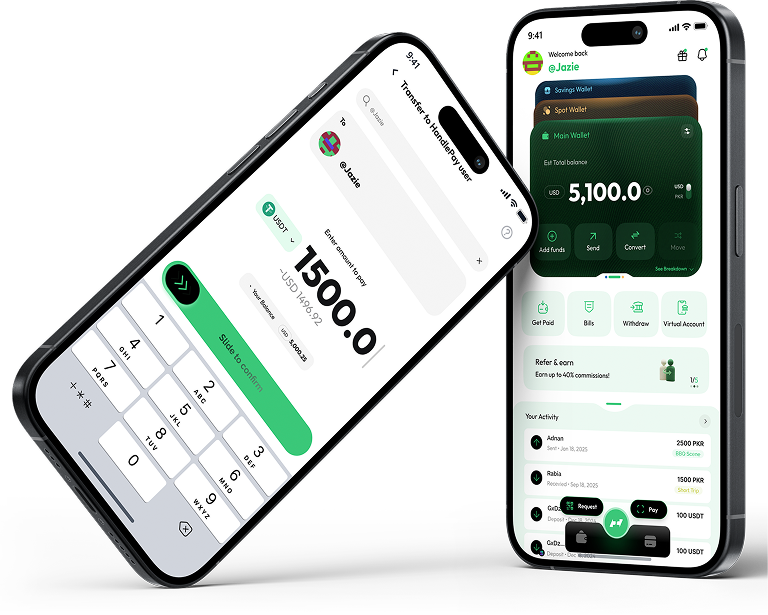
Download HandlePay and create your account with a username and a passkey
Verify your identity once
That's what puts the account in your own name.
Request your USD account and copy your US account details from the app
Send them to your client: ACH for clients in the US, SWIFT for clients anywhere else
Keep the money in dollars, and cash out to any Pakistani bank in your name when you choose
It lands within minutes, at the Google rate.
Only you can move your money once it lands.
Get your dollar account
US account details in your own name. Get paid by ACH or SWIFT, keep it in dollars, and cash out to PKR when you choose.
Sources
- Dawn, "Freelancers earn $1.76bn", 21 Jul 2026
- Business Recorder, "Dollar's rate in interbank market", 23 Oct 2026
- PakTribune, "Rupee closes at 276.82 per dollar after another marginal gain" (SBP revaluation rate 276.8236), 23 Oct 2026
- Profit by Pakistan Today, "Rupee dips to lowest ever against dollar", 22 Aug 2023
- Business Recorder, "IT firms, freelancers exempted from declaring export proceeds of up to $25,000", 6 Apr 2026
- State Bank of Pakistan, BPRD Circular No. 05 of 2023, Framework for Freelancers Accounts
- Payoneer, Terms and Conditions (Payoneer Inc., April 2026), section 17.6
- The Express Tribune, "Payoneer imposes 3% withdrawal fee on Pakistani users, raising concerns among freelancers", 3 May 2025
- ProPakistani, "PayPal enters small South Asian country while Pakistanis still struggle with international payments", 20 May 2026
- Nacha, "How ACH Payments Work", checked 25 Oct 2026
- Chase, "What are wire transfer fees?" (intermediary bank fees), checked 25 Oct 2026
- Upwork Help, "Direct to U.S. Bank", checked 25 Oct 2026
- Fiverr Help, "Withdrawing your earnings & managing payout methods", checked 25 Oct 2026
FAQs
HandlePay Team
Our mission is to make international money work for everyday people, freelancers, and businesses in Pakistan.